





Clarity OS: The AI Mission Control

Level 1 — The Mental Model
Cards 1–5The foundational lens through which Clarity OS is understood. Click on a card to get & listen to the answer. Jump from a section to another with the lateral sliding menu : the three bars on you right.
Q1
What is Clarity OS?
tap to reveal
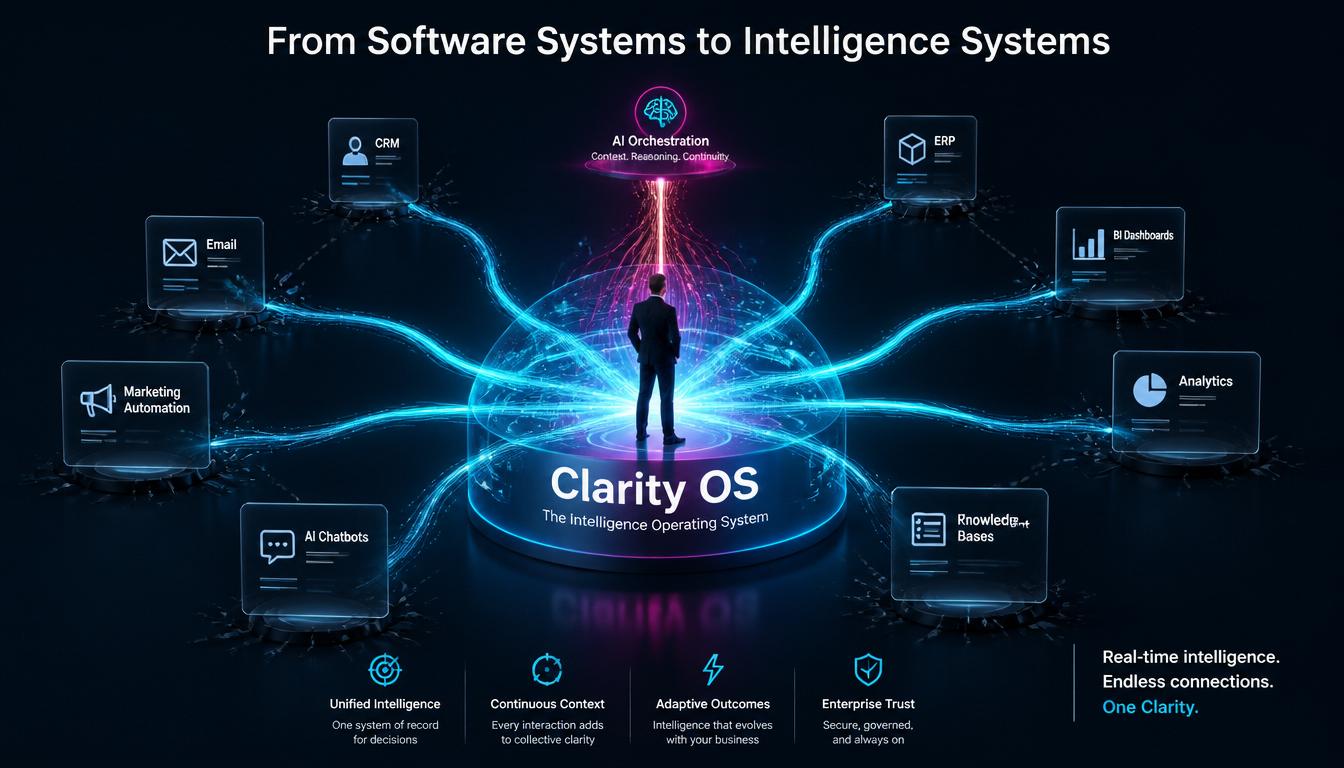
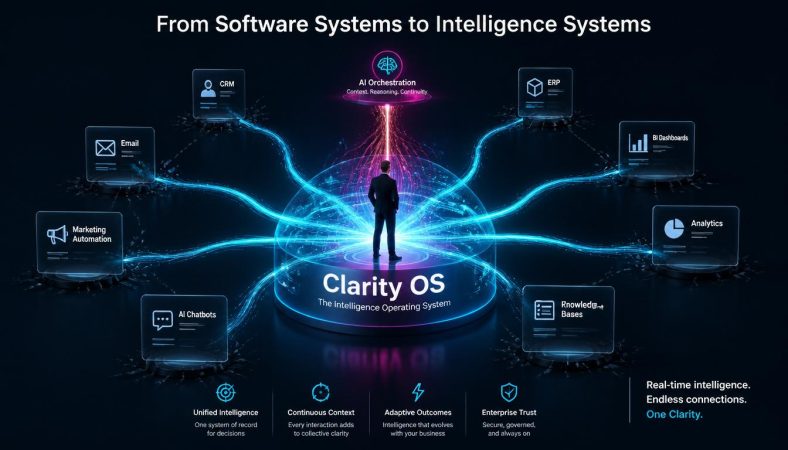
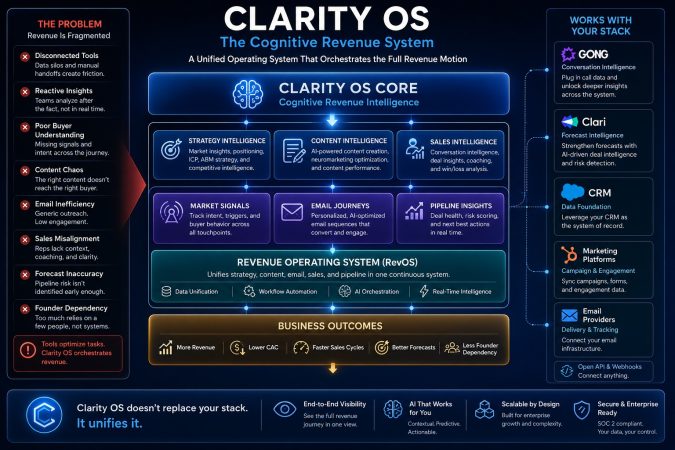
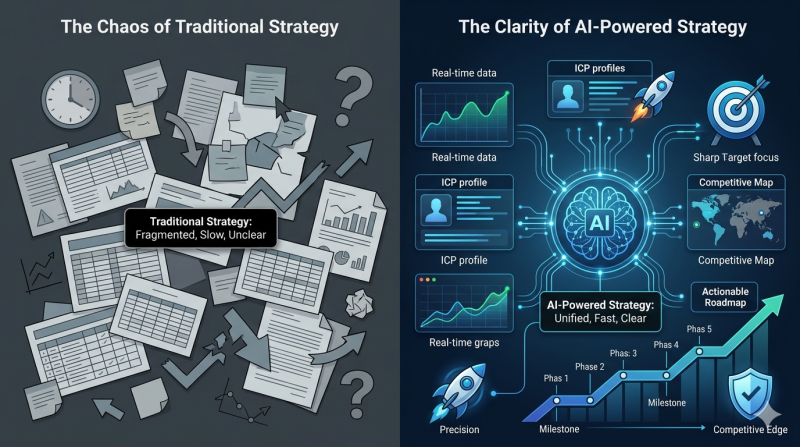
An AI Growth Operating System that turns fragmented business information, market signals, customer intelligence, and executive decisions into connected commercial action.
core definition
Q2
What problem does Clarity OS solve?
tap to reveal
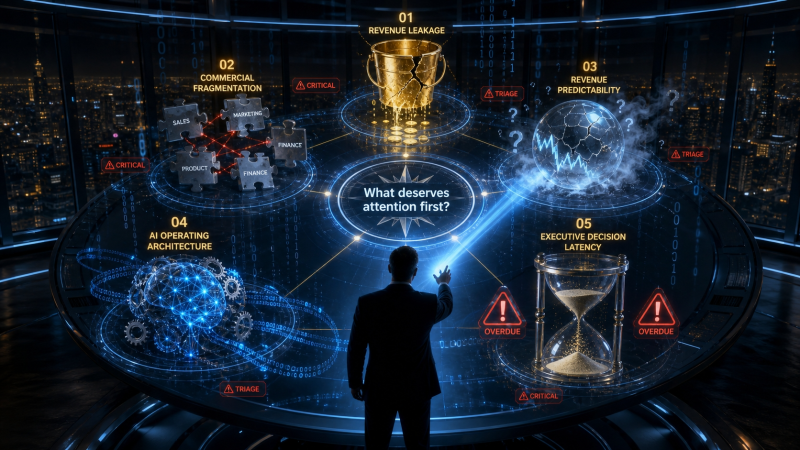
The gap between having information and being able to turn that information into coordinated decisions, content, sales actions, and revenue.
problem statement
Q3
What is the simplest way to explain Clarity OS?
tap to reveal
It connects what the business knows to what the business should do next.
elevator pitch
Q4
What makes Clarity OS different from simply using ChatGPT?
tap to reveal
ChatGPT primarily responds to prompts. Clarity OS provides business context, structured intelligence, specialized missions, orchestration, memory, and execution workflows.
differentiation
Q5
What is the fundamental Clarity OS transformation?
tap to reveal
Fragmented information → Intelligence → Decision → Action → Commercial outcomecore flow
Level 2 — Why It Exists
Cards 6–9The underlying drivers that make Clarity OS necessary.
Q6
Why is fragmented information a business problem?
tap to reveal
Because customer information, strategy, market signals, content, sales activity, and decisions often live in disconnected places.
fragmentation
Q7
What happens when AI is used without an operating system?
tap to reveal
Employees create isolated conversations, prompts, documents, and outputs that are difficult to connect, reuse, govern, or turn into coordinated action.
AI without OS
Q8
What does Clarity OS centralize?
tap to reveal
Business knowledge, context, signals, reasoning, missions, artifacts, decisions, and execution.
centralization
Q9
What is the key economic problem Clarity OS addresses?
tap to reveal
The cost of disconnected intelligence and the revenue lost when good information does not become timely action.
economic driver
Level 3 — The Intelligence Layer
Cards 10–15The foundational layer that gives AI access to business context.
Q10
What is the Intelligence Layer?
tap to reveal
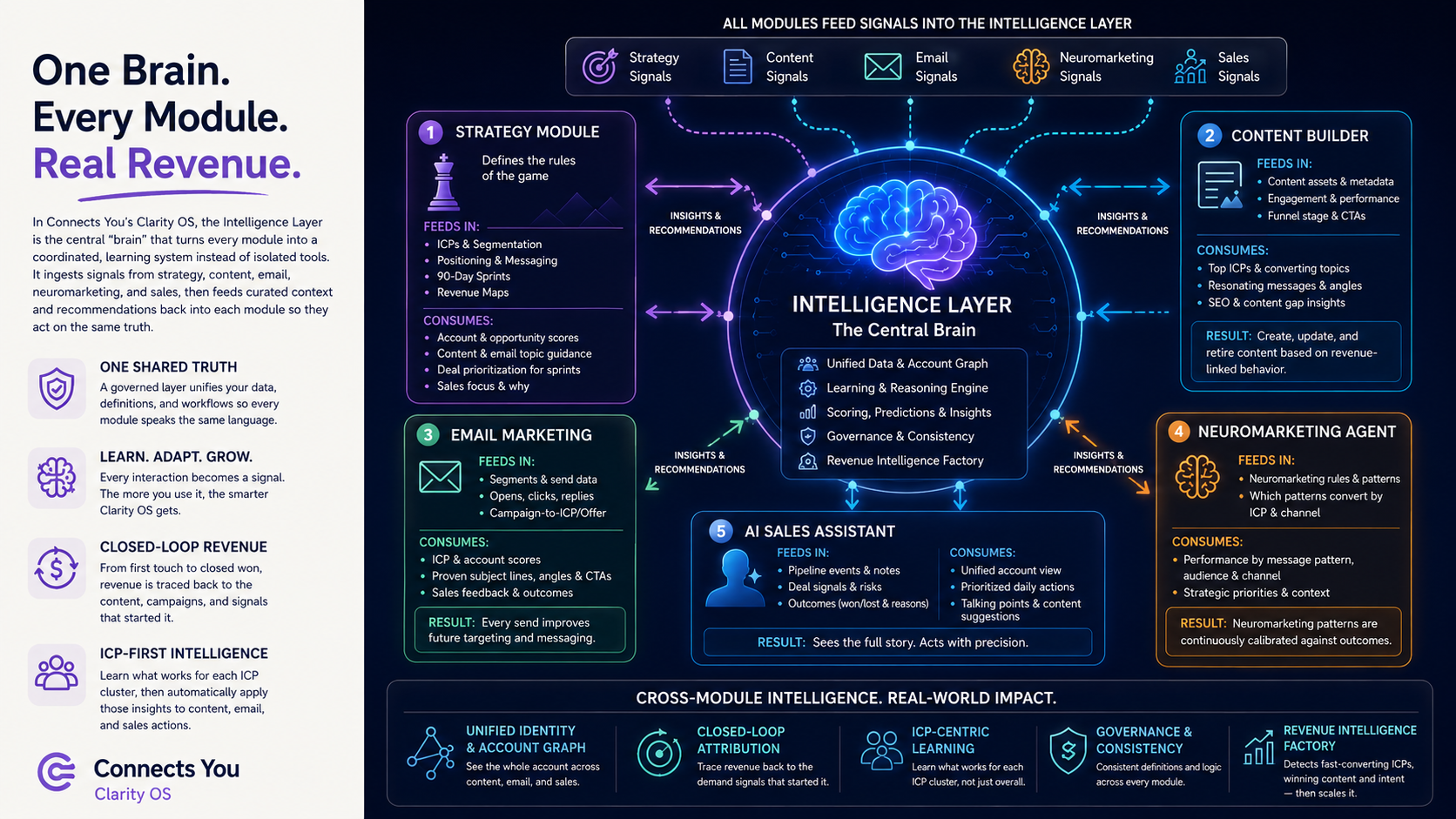
The underlying layer that gives AI access to the business context required to reason consistently.
intelligence layer
Q11
What does business memory provide?
tap to reveal
Persistent knowledge about the company, offers, customers, ICPs, positioning, brand, processes, evidence, and previous decisions.
business memory
Q12
Why does context matter?
tap to reveal
The same question produces radically different answers depending on the company’s strategy, market, customer, offer, evidence, and constraints.
context importance
Q13
What does the Context Engine do?
tap to reveal
It assembles the relevant business information for a specific reasoning task.
context engine
Q14
What does orchestration do?
tap to reveal
It coordinates specialized AI capabilities so multiple reasoning steps can contribute to one coherent outcome.
orchestration
Q15
What is the difference between an AI agent and Clarity OS?
tap to reveal
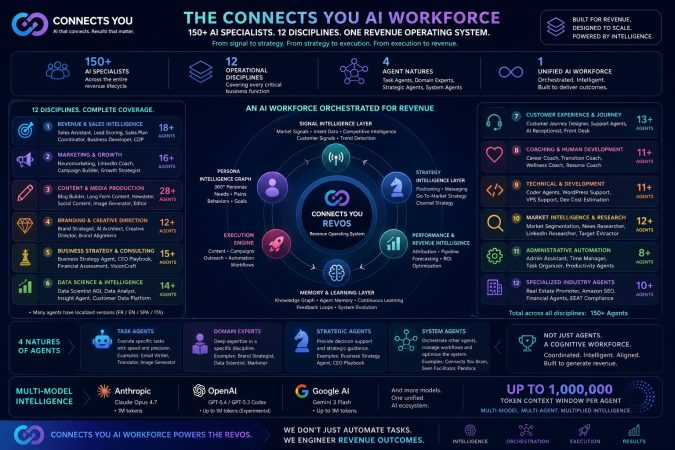
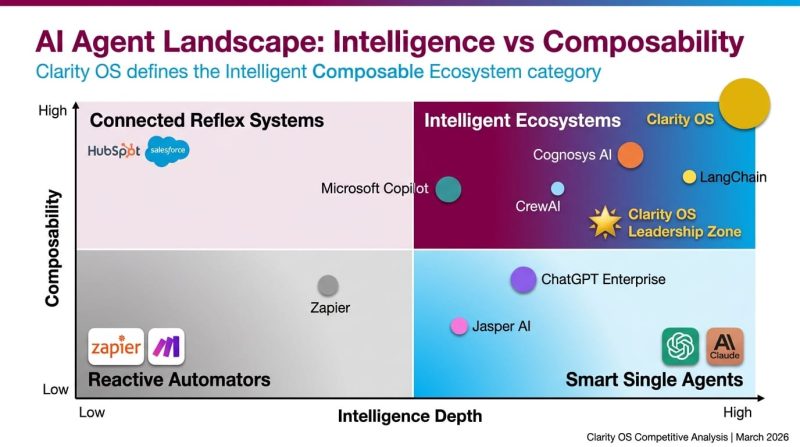
An agent performs a specialized task; Clarity OS coordinates multiple specialized intelligence capabilities around a business objective.
agent vs OS
Level 4 — Modules
Cards 16–21Specialized intelligence environments for specific business domains.
Q16
What is a Clarity OS module?
tap to reveal
A specialized intelligence environment designed around a particular business domain or capability.
module definition
Q17
What does the Business Strategy Module help with?
tap to reveal
Strategic analysis, business direction, positioning, market opportunities, priorities, and strategic decisions.
strategy module
Q18
What does the Neuromarketing capability contribute?
tap to reveal
Buyer psychology, attention, motivation, emotional drivers, cognitive friction, persuasion, and decision triggers.
neuromarketing
Q19
What does the Content Builder do?
tap to reveal
Converts business intelligence and expertise into strategically aligned content and communication assets.
content builder
Q20
What does the Email Marketing Module do?
tap to reveal
Converts intelligence into targeted email communication, nurturing, campaigns, and follow-up sequences.
email marketing
Q21
What does the AI Sales Assistant do?
tap to reveal
Converts prospect and account information into sales intelligence, conversation strategy, qualification, and next actions.
sales assistant
Level 5 — Missions
Cards 22–27Defined intelligence-and-execution tasks for specific business outcomes.
Q22
What is a mission in Clarity OS?
tap to reveal
A defined intelligence-and-execution task designed to produce a specific business outcome.
mission definition
Q23
Why are missions important?
tap to reveal
They turn AI from an open-ended chat experience into a repeatable business process.
mission importance
Q24
What does a mission produce?
tap to reveal
One or more usable artifacts, decisions, recommendations, or execution outputs.
mission output
Q25
What is an artifact?
tap to reveal
A tangible output produced by a mission that can be reviewed, shared, implemented, or used as input for another mission.
artifact definition
Q26
Why connect missions together?
tap to reveal
Because one piece of intelligence can become the context for the next commercial action.
mission chaining
Q27
What is the mission economy?
tap to reveal
The system for defining, valuing, packaging, and potentially pricing individual intelligence missions and their resulting artifacts.
mission economy
Level 6 — Guided Sprints
Cards 28–31Orchestrated sequences of missions toward a defined outcome.
Q28
What is the difference between using Clarity OS manually and using a guided sprint?
tap to reveal
Manual use lets the user choose individual capabilities; a guided sprint orchestrates a sequence of missions toward a defined outcome.
manual vs sprint
Q29
What is the purpose of guided sprints?
tap to reveal
To make sophisticated intelligence accessible without requiring the user to know which AI capability to invoke next.
sprint purpose
Q30
What is the “automatic driving” analogy?
tap to reveal
Manual mode is like driving yourself through individual modules; guided mode is like giving Clarity OS the destination and letting it coordinate the journey.
driving analogy
Q31
What makes a sprint valuable?
tap to reveal
It should move the user from a recognizable business problem to a tangible commercial artifact within a defined experience.
sprint value
Level 7 — Production Labs
Cards 32–38Structured, time-boxed experiences for solving real business problems.
Q32
What is a Production Lab?
tap to reveal
A structured, time-boxed experience where a participant uses Clarity OS to solve a real business problem and leave with a finished artifact.
production lab
Q33
What is the philosophy behind Production Labs?
tap to reveal
Don’t demonstrate AI. Produce something useful with it.
lab philosophy
Q34
What does “Find Your Best Customer” produce?
tap to reveal
ICP candidates, comparison, buyer psychology, needs, objections, triggers, conversation probability, and a market-fit hypothesis.
best customer lab
Q35
What does “Build an Offer People Understand” solve?
tap to reveal
It turns what a company sells into an offer customers can quickly understand and evaluate.
offer lab
Q36
What does “Turn Your Expertise Into a Content Engine” produce?
tap to reveal
A structured content system capable of generating approximately 30 days of strategically aligned content.
content engine lab
Q37
What does “Build Your AI Sales Assistant” solve?
tap to reveal
It transforms messy prospect information into structured intelligence and a sales action plan.
sales assistant lab
Q38
What does “From Idea to Market” accomplish?
tap to reveal
It takes one business idea and turns it into an executable initial commercial campaign.
idea to market lab
Level 8 — The Commercial Loop
Cards 39–42The core loop that turns intelligence into revenue.
Q39
What is the core Clarity OS loop?
tap to reveal
Observe → Understand → Decide → Create → Engage → Learn → Actcore loop
Q40
Where does market intelligence enter the system?
tap to reveal
Through signals, research, customer information, prospect intelligence, business data, and external evidence.
market intelligence
Q41
Where does revenue enter the system?
tap to reveal
When intelligence is converted into actions affecting acquisition, positioning, conversion, retention, expansion, or operational efficiency.
revenue entry
Q42
What is the ultimate test of a Clarity OS output?
tap to reveal
Can someone actually do something commercially useful with it?
ultimate test
Level 9 — PQS & GTM Intelligence
Cards 43–47Prospect qualification and go-to-market signal detection.
Q43
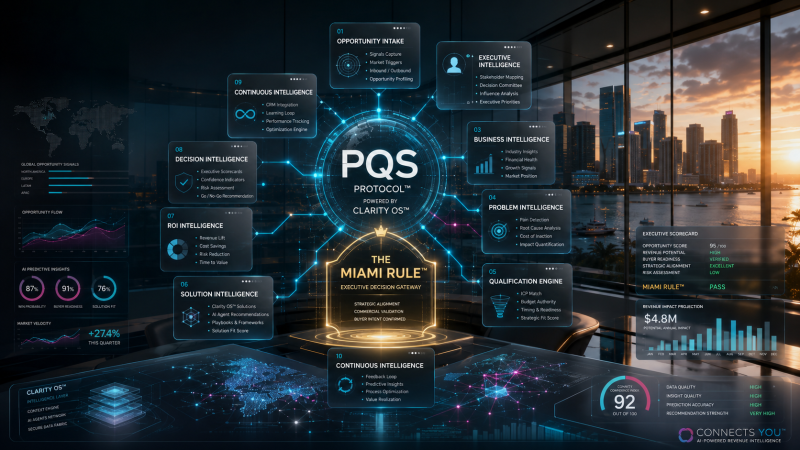
What is PQS?
tap to reveal
The Prospect Qualification System used to identify and prioritize commercially relevant prospects based on observable signals.
PQS definition
Q44
What does GTM Signal Intelligence detect?
tap to reveal
Signals such as hiring, leadership changes, expansion, product launches, market expansion, funding, partnerships, M&A, strategic announcements, and AI/digital transformation.
GTM signals
Q45
Why are GTM signals valuable?
tap to reveal
They indicate moments when a company may have a new problem, budget, initiative, urgency, or buying trigger.
signal value
Q46
What is the difference between a signal and a conclusion?
tap to reveal
A signal is evidence; a conclusion is an interpretation. Clarity OS should distinguish the two.
signal vs conclusion
Q47
What is the Miami Rule in PQS?
tap to reveal
The buyer-intent overlay that helps distinguish general qualification from signals suggesting a prospect may be more commercially actionable now.
Miami Rule
Level 10 — The Big Picture
Cards 48–53The strategic advantage of connected intelligence.
Q48
What happens when Clarity OS receives business context?
tap to reveal
It can reason from that context rather than treating every interaction as an isolated conversation.
context reasoning
Q49
What happens when intelligence is connected across modules?
tap to reveal
Outputs from one capability can become structured inputs for another.
connected intelligence
Q50
What is the strategic advantage of connected intelligence?
tap to reveal
The business stops repeatedly rediscovering what it already knows.
strategic advantage
Q51
What is Clarity OS really selling?
tap to reveal
Not AI generation. It is selling a faster path from business uncertainty to informed commercial action.
core value prop
Q52
Complete: “Clarity OS is not…”
tap to reveal
“…another chatbot or collection of disconnected AI tools.”
what it’s not
Q53
Complete: “Clarity OS is…”
tap to reveal
“…an operating environment for turning business intelligence into coordinated action.”
what it is
⚡ The 10‑Second Mental Model
memorize this
Context + Intelligence + Orchestration + Execution = Clarity
If you can explain these two models naturally, you understand the foundation of Clarity OS.
Ready to transform your commercial intelligence?
Let’s discuss how Clarity OS can turn your business uncertainty into informed commercial action.
Book a 30-Minute Meeting