




Why 90% of Your ‘Leads’ Are Waste: The Case for Commercial Judgment Over Data Volume
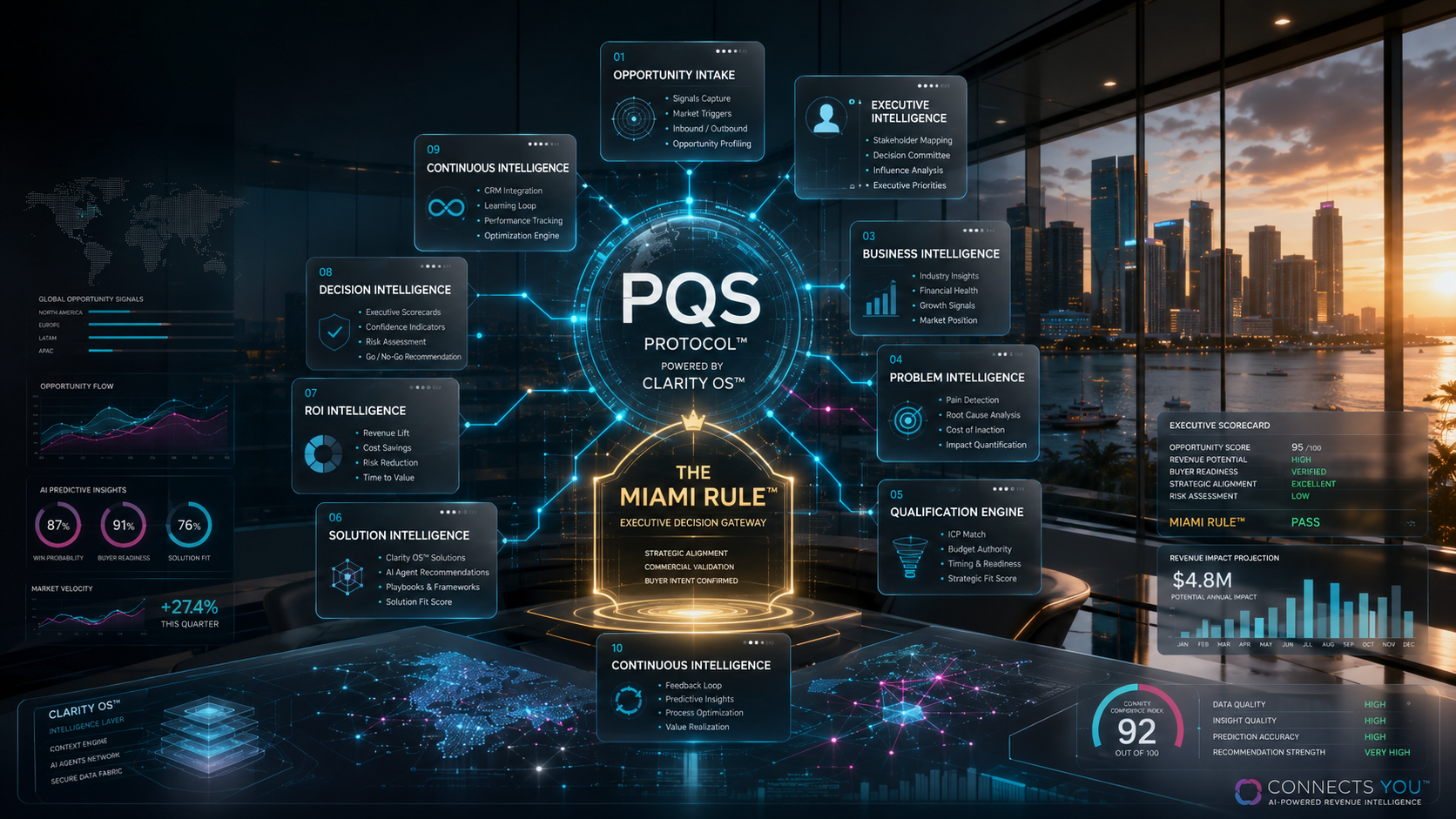
The $10B Problem
“Revenue intelligence is a $10+ billion industry. And yet, the average sales team wastes 80% of their time on unqualified leads. Why? Because the data providers everyone relies on — ZoomInfo, Apollo, Lusha — answer the wrong question.”
Key Insight: They tell you who is out there. They cannot tell you who is actually ready to buy your specific solution.
The Data vs. Intelligence Framework
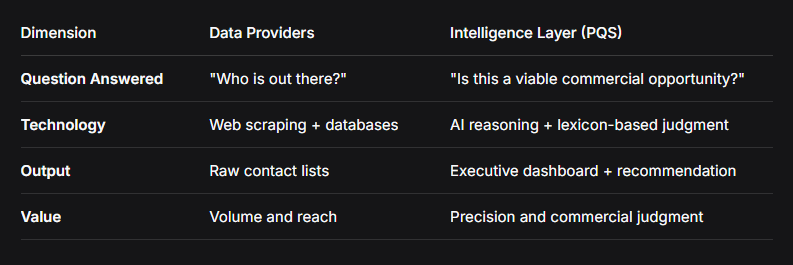
Introducing the core distinction:
📈 Evolution of Players in Data vs. Intelligence
Last decade (2016 – 2026) – move your cursor over the chart
Year
—
📦 Data Providers
—
🧠 Intelligence Providers
—
⚡ Intel / Data Ratio
—
The Five Critical Gaps
Gap 1: No Commercial Judgment
“A VP of Revenue who is actively evaluating RevOS and a consultant who sells RevOps advisory services look identical to ZoomInfo. Both have ‘VP of Revenue’ in their title. Both work at relevant companies. Both appear in search results. But one is a $50,000 opportunity. The other is a time-waster who will probe your pricing and never buy.”
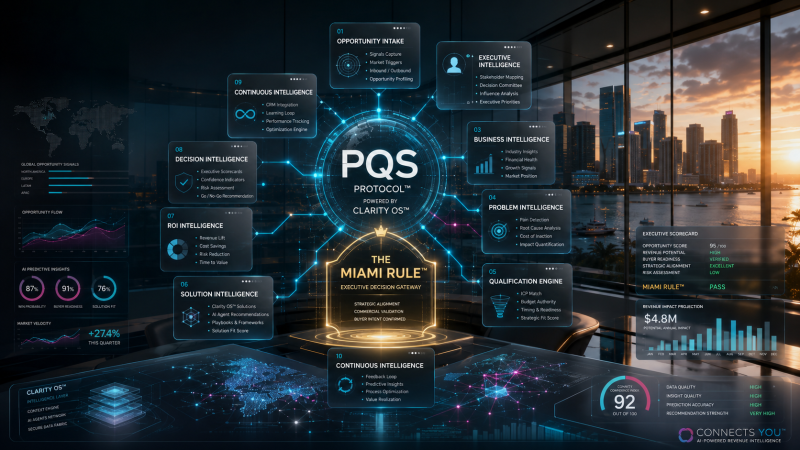
The PQS Difference: Applies sentiment context — distinguishes between buyer language (“our forecasting is broken”) and seller language (“we help clients forecast”).
Gap 2: No Miami Rule
“Solopreneurs with no buying authority. ‘Partnership’ hunters with no clients. Consultants looking for free education. Traditional data providers return them all as ‘leads.’ Worse — they encourage you to spend executive cycles on ‘exploratory calls’ that go nowhere.”
The PQS Difference: Applies zero-tolerance filters:
- Rule 1: Probing without pain → Disqualify
- Rule 2: Unverified partnership → Disqualify
- Rule 3: <3 employees → Disqualify
- Rule 4: Third-party agenda → Disqualify
Gap 3: No Sentiment Context
“When a prospect says ‘forecasting fragmentation,’ are they describing a problem they need solved or a service they sell? Data providers don’t know. They see the keyword and classify it as ‘intent.’ This is a catastrophic error. One signals a $50,000 deal. The other signals a waste of your time.”
The PQS Difference: Analyzes who owns the problem:
- “Our forecasting fragmentation is costing us 8% revenue.” → Buyer context → Immediate Meeting
- “We help clients solve forecasting fragmentation.” → Seller context → Disqualify
Gap 4: No Product-Aligned Lexicon
“ZoomInfo doesn’t know what Clarity OS or CRS RevOS does. It can’t score a prospect against your specific product capabilities. It returns anyone with ‘Revenue Operations’ in their title — regardless of whether they need AI agent orchestration, revenue lifecycle unification, or enterprise intelligence.”
The PQS Difference: Applies a Tier 1-3 vocabulary lexicon mapped directly to product capabilities:
- Tier 1: “coordinated intelligence,” “unifies revenue-generating functions” → Immediate Meeting
- Tier 2: “sales execution bottlenecks,” “CRM intelligence gaps” → Discovery Call
- Tier 3: “predictive analytics,” “hypergrowth” → Elevates ICP match
Gap 5: No Scoring Dashboard
“Data providers give you lists. They do not give you judgment. They cannot tell you if a prospect has a 85% Buying Readiness Score or a 12% ICP Match. They cannot synthesize evidence, identify risks, or recommend a next action. You have to do that yourself — manually, inconsistently, and slowly.”
The PQS Difference: Generates a multidimensional Executive Dashboard:
- ICP Match % (0-100%)
- Buying Readiness Score (0-100%)
- Opportunity Score (0-100%)
- Trust Score (0-100%)
- Risk Analysis (6 risk dimensions)
- Recommended Next Action (Immediate Meeting | Discovery Call | Disqualify)
- Evidence Confidence (0-100%)
The Cost of These Gaps
| Metric | Impact |
| Time wasted on unqualified leads | 80% of sales development cycles |
| Executive hours spent on “exploratory calls“ | 15+ hours per week |
| Deals lost to poor qualification | 30% of pipeline |
| Reputation damage from chasing unqualified prospects | Immeasurable |
The Solution: The PQS Protocol
Ourt four points brief approach:
- Data Acquisition: Use ZoomInfo/Apollo (paid) for initial list generation or Google dork or Linkedin Search *free)
- Strategic Segmentation: Semi-manual LinkedIn search + screenshot capture
- Intelligence Analysis: PQS protocol with product-aligned lexicon + Miami Rule
- Outreach Execution: Only prospects scoring ≥ 65 (Discovery Call) or ≥ 85 (Immediate Meeting)
The Results
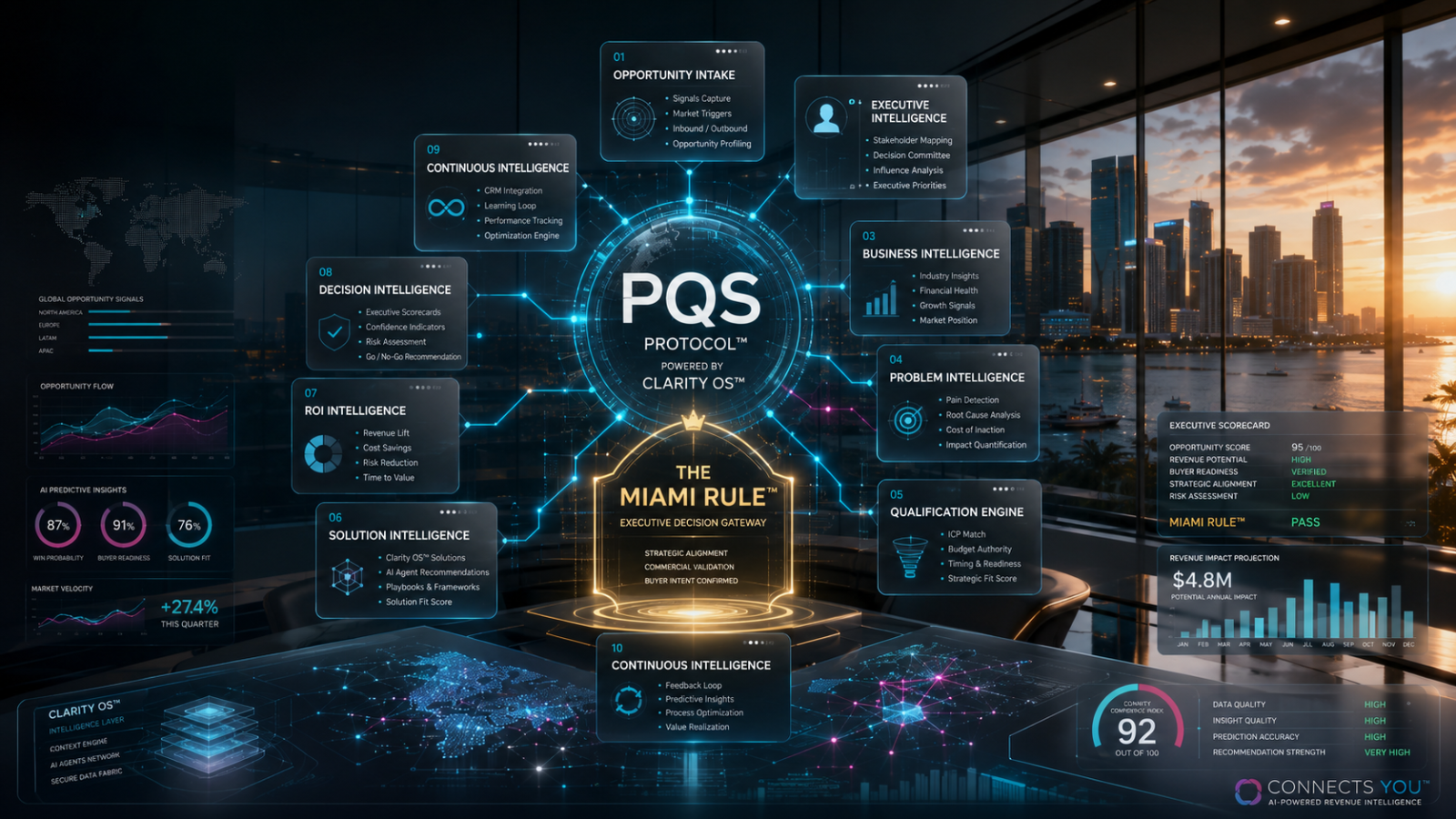
- 80% reduction in time wasted on unqualified leads
- 3x increase in meeting conversion rates
- 100% elimination of “exploratory calls” with non-buyers
- Clear ROI on every executive hour spent on prospecting
7. Call to Action
“Stop treating data volume as a proxy for revenue intelligence. The market is saturated with data. What’s missing is judgment. The PQS protocol provides the commercial judgment that data providers cannot.”
Why are 90% of leads considered waste?
+
Because data providers like ZoomInfo, Apollo, and Lusha focus on who is out there rather than who is ready to buy your specific solution. This leads to sales teams wasting 80% of their time on unqualified leads.
What is the Data vs. Intelligence Framework?
+
The framework distinguishes between data (who exists) and intelligence (who is ready to buy). Traditional data providers lack commercial judgment, sentiment context, and product-aligned scoring.
What are the Five Critical Gaps in lead qualification?
+
- No Commercial Judgment: Fails to distinguish between buyers and sellers.
- No Miami Rule: Includes solopreneurs, consultants, and non-buyers.
- No Sentiment Context: Misinterprets buyer vs. seller language.
- No Product-Aligned Lexicon: Cannot score prospects based on your solution.
- No Scoring Dashboard: Lacks ICP Match, Buying Readiness, and Opportunity Scores.
How does the PQS Protocol solve these gaps?
+
PQS applies:
- Sentiment context to distinguish buyer vs. seller language.
- Zero-tolerance filters (Miami Rule) to disqualify non-buyers.
- Product-aligned lexicon (Tier 1-3 vocabulary).
- Multidimensional scoring dashboard (ICP Match, Buying Readiness, etc.).
What results can I expect from the PQS Protocol?
+
- 80% reduction in time wasted on unqualified leads.
- 3x increase in meeting conversion rates.
- 100% elimination of exploratory calls with non-buyers.
- Clear ROI on executive hours spent prospecting.