




The Lead Qualification Problem Nobody Wants to Measure.
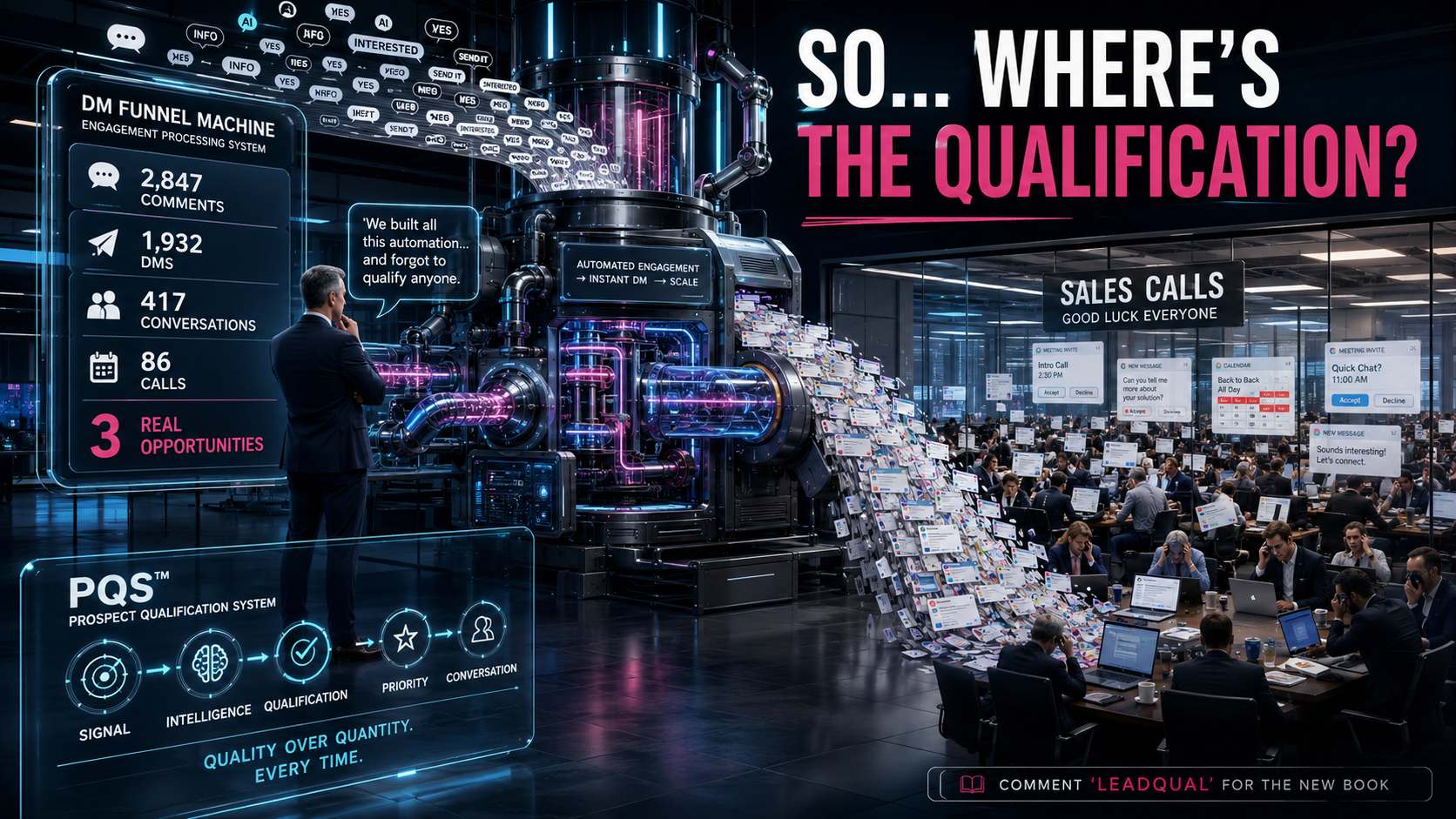
The playbook is consistent. Post. Comment “AI.” DM. Start a conversation. Book a call. It works. That is precisely why it is dangerous—because a mechanism can generate activity without generating commercial intelligence.
The funnel converts attention into conversations. But conversations are not opportunities. The critical question isn’t “How many people can I get into a DM?” but “Which of these people represent a credible commercial opportunity?”
Most funnels treat every response as a sales opportunity. They don’t examine whether someone has a business problem, authority, urgency, or budget. The old model asks who responded. The smarter approach—Prospect Qualification Systems—asks who deserves attention.
In an era of automated engagement, the competitive advantage is not getting someone to respond. It is knowing what their response actually means.
For years, the playbook has been remarkably consistent.
Create a post.
Ask people to comment a keyword.
Send them a DM.
Start a conversation.
Move them toward a call.
It works.
That is precisely why it is dangerous.
Because a mechanism can generate activity without generating commercial intelligence.
The problem is not the DM…
The problem is what happens before the DM.
Most comment-to-DM funnels treat every response as a potential sales opportunity.
Someone comments “AI.”
Someone comments “INFO.”
Someone comments “YES.”
The automation fires.
A conversation begins.
And suddenly the marketer has a pipeline full of people who expressed curiosity but have not demonstrated a business problem, commercial relevance, authority, urgency, budget, strategic alignment, or willingness to change.

The funnel has successfully converted attention into conversations.

But conversations are not opportunities.

That distinction matters.

The real question is not:

“How many people can I get into a DM?”

It is:

“Which of these people represent a credible commercial opportunity, and why?”

That is where the conventional funnel breaks down.
The missing layer is qualification.
Not qualification in the traditional SDR sense of checking whether someone has a budget and a timeline.
Qualification as revenue intelligence.
You need to understand the prospect before you invest scarce human attention in them.
What problem are they actually trying to solve?
How costly is that problem?
Does it affect revenue, productivity, risk, growth, or strategic execution?
Does the person have influence over the problem?
Is there organizational urgency?
Is there a credible reason to act now?
Does the company fit the ICP?
Is the problem sufficiently important to justify intervention?
And perhaps most importantly:
Is there evidence that this is a buying situation rather than merely an interesting conversation?
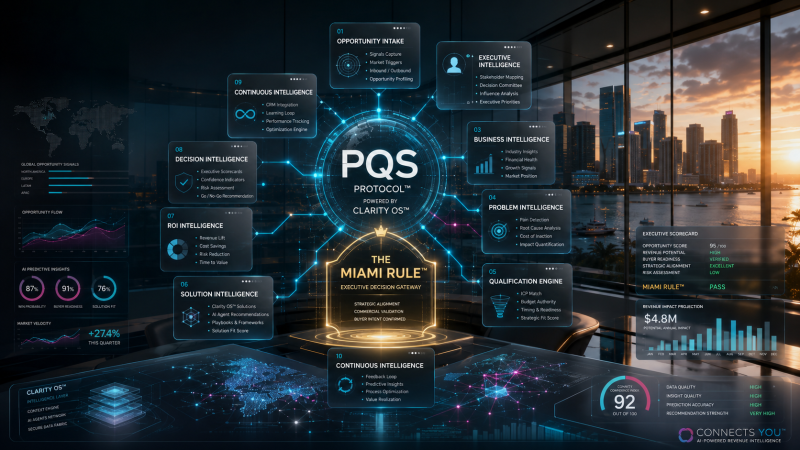
That is the fundamental difference between a DM funnel and PQS.
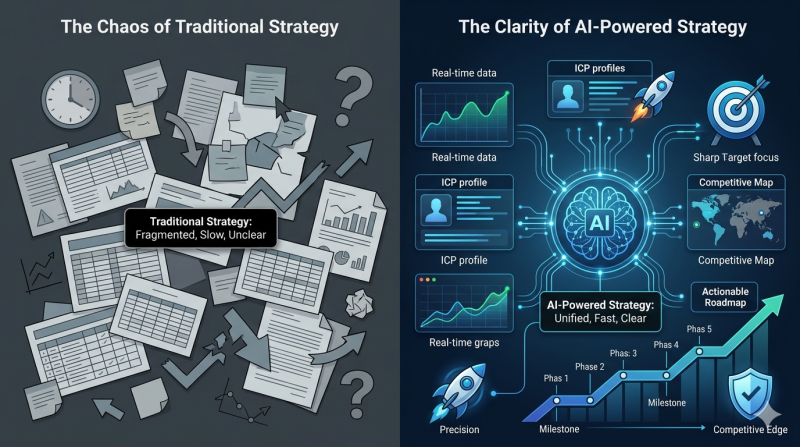
Traditional Funnel vs PQS Protocol
-
The missing layer is qualification.
-
“let’s jump on a quick call”
-
There is another problem with the conventional model.
-
Automation should not replace judgment.
The missing layer is qualification.
Not qualification in the traditional SDR sense of checking whether someone has a budget and a timeline.
Qualification as revenue intelligence.
You need to understand the prospect before you invest scarce human attention in them.
What problem are they actually trying to solve?
How costly is that problem?
Does it affect revenue, productivity, risk, growth, or strategic execution?
Does the person have influence over the problem?
Is there organizational urgency?
Is there a credible reason to act now?
Does the company fit the ICP?
Is the problem sufficiently important to justify intervention?
And perhaps most importantly:
Is there evidence that this is a buying situation rather than merely an interesting conversation?
That is the fundamental difference between a DM funnel and PQS.
A DM funnel asks:
“Who responded?”
PQS asks:
“Who should we care about?”
That sounds like a subtle distinction.
It isn’t.
It changes the architecture of the entire revenue process.
The old model is:
Attention → Engagement → Comment → DM → Call → Qualification
The PQS model reverses the logic:
Signal → Intelligence → Qualification → Commercial Priority → Conversation → Opportunity
The conversation becomes the consequence of qualification, not the mechanism for discovering whether qualification exists.
That is strategically important.
Because executive time is not free.
Every unnecessary discovery call consumes attention that could have been spent with a genuinely qualified buyer.
Every low-quality DM creates noise.
Every “let’s jump on a quick call” from someone who has not established a meaningful business problem transfers the cost of qualification from the system to the salesperson.
And at scale, that becomes expensive.
This is why the obsession with booked calls can become misleading.
A marketer can proudly report:
- “We generated 200 conversations.”
The revenue leader should immediately ask:
- “How many were commercially qualified?”
Then:
- “How many had an identifiable business problem?”
- “How many matched our ICP?”
- “How many had decision influence?”
- “How many demonstrated urgency?”
- “How many represented meaningful economic value?”
- “How many progressed?”
- “How many became revenue?”
The difference between those numbers is where the real economics of the funnel live.
PQS exists in that gap.
It is not another lead-generation tactic.
It is a Prospect Qualification System designed to determine whether attention should become sales attention.
That makes it fundamentally different from a generic comment-to-DM mechanism.
The DM funnel is optimized for response.
PQS is optimized for judgment.
The DM funnel measures engagement.
PQS measures commercial relevance.
The DM funnel tries to maximize conversations.
PQS tries to minimize unnecessary conversations while increasing the probability that the right conversations happen.
And that is a much more sophisticated objective.
There is another problem with the conventional model.
It assumes that intent is obvious.
It isn’t.
A person can comment on an AI post because they are curious.
- They can download a framework because they like the topic.
- They can respond to a CTA because they want information.
- They can accept a DM because they are polite.
None of those actions necessarily indicate buying intent.
Intent is contextual.
PQS therefore needs to look beyond the surface signal.
It examines the relationship between the person, the company, the problem, the economic consequence, the strategic context, and the evidence of readiness.
That creates something a conventional funnel rarely produces:
A reasoned commercial assessment.
Not:
“John commented AI. Send him a DM.”
But:
“John is a senior revenue executive at an ICP-fit company. His organization is experiencing a problem directly related to the capability we provide. The problem has identifiable commercial consequences. He appears to have influence over the relevant function. Recent signals suggest the issue is active rather than hypothetical. This prospect warrants human attention.”
That is a completely different level of intelligence.
And it leads to a different definition of automation.
Automation should not replace judgment.
It should improve the quality of judgment.
It should improve the quality of judgment.
That is the opportunity.
The next generation of revenue systems will not win by producing the most DMs.
They will win by identifying the highest-value opportunities before human attention is deployed.
The question is no longer:
“How do we get more people into the funnel?”
It is:
“How do we determine who deserves to move through it?”
That is why PQS is strategically more valuable than a generic comment-to-DM funnel.
- The funnel creates conversations.
- PQS creates commercial intelligence.
And in an environment where everyone’s inbox is automated, everyone’s CTA is optimized, and everyone’s LinkedIn feed is engineered to generate engagement, the competitive advantage is no longer getting someone to respond.
It is knowing what their response actually means.
And suddenly the marketer has a pipeline full of people who expressed curiosity but have not demonstrated a business problem, commercial relevance, authority, urgency, budget, strategic alignment, or willingness to change.
The funnel has successfully converted attention into conversations.
But conversations are not opportunities.
The real question is not:
“How many people can I get into a DM?”
It is:
“Which of these people represent a credible commercial opportunity, and why?”
That is where the conventional funnel breaks down.
The missing layer is qualification.
Not qualification in the traditional SDR sense of checking whether someone has a budget and a timeline.
Qualification as revenue intelligence.
You need to understand the prospect before you invest scarce human attention in them.
What problem are they actually trying to solve?
How costly is that problem?
Does it affect revenue, productivity, risk, growth, or strategic execution?
Does the person have influence over the problem?
Is there organizational urgency?
Is there a credible reason to act now?
Does the company fit the ICP?
Is the problem sufficiently important to justify intervention?
And perhaps most importantly:
Is there evidence that this is a buying situation rather than merely an interesting conversation?
Executive outcome model
I would track five outcomes over a 12-month illustrative period:
| Executive outcome | Traditional funnel | PQS model |
|---|---|---|
| Engagement volume | High | Moderate |
| Unqualified conversations | Rising | Declining |
| Sales capacity consumed | Rising | Controlled |
| Qualified opportunity density | Low / unstable | Increasing |
| Executive confidence in pipeline | Low / unstable | Increasing |
The more credible story is:
Month 1–3: PQS introduces friction because the organization begins qualifying more aggressively.
Month 4–6: low-value conversations decline.
Month 7–9: sales capacity begins concentrating around higher-priority prospects.
Month 10–12: opportunity density and executive confidence improve.
From Activity to Commercial Signal
Illustrative 12‑month operating model: traditional LinkedIn bait‑to‑call funnel vs PQS qualification architecture
⚠️ Illustrative model — not empirical performance data⏱ Month 1 → Month 12 · Indexed metrics (Month 1 = 100)
Unqualified conversations ↓ lower is better
Traditional
PQS
Sales capacity consumed ↓ lower is better
Traditional
PQS
Qualified opportunity density ↑ higher is better
Traditional
PQS
Executive pipeline confidence ↑ higher is better
Traditional
PQS
The numbers are deliberately indexed rather than expressed as dollars or percentages.
The visual approach
These animation should tell the essentials in approximately 20–30 seconds.
Fact # 1 — The bait funnel
From Activity to Commercial Signal
Illustrative operating model — step‑by‑step signal evolution
1 / 6
Fact # 2 — The executive discovers the problem
From Activity to Commercial Signal
The executive discovers the problem — step by step
1 / 6
Fact # 3 — PQS enters upstream
From Activity to Commercial Signal
Introduce PQS before the calendar — qualification architecture
1 / 7
Only qualified signals progress.
fact # 4 — The trajectories diverge
The traditional funnel continues producing more activity.
The PQS model produces fewer but increasingly valuable conversations.
The visualization should make one principle visually obvious:
PQS does not necessarily maximize conversations.
It maximizes the probability that the right conversation happens.
The executive conclusion
This is ultimately not an argument against LinkedIn.
It is not even an argument against comment-to-DM funnels.
Those mechanisms can have legitimate uses.
The problem begins when engagement is mistaken for qualification.
A comment can be a signal.
A DM can be a signal.
A meeting request can be a signal.
But none of them, by themselves, tell an executive whether the prospect represents a commercially meaningful opportunity.
That requires interpretation.
And interpretation requires intelligence.
That is the role PQS is designed to play.
The future of B2B revenue generation will not belong exclusively to the organization that generates the most engagement.
It will belong to the organization that can interpret engagement better than its competitors.
Because when everybody can automate the DM, the DM stops being the competitive advantage.
When everybody can manufacture meetings, meetings stop being the KPI.
The advantage moves upstream.
Who is actually worth pursuing?
Why?
Why now?
What makes the opportunity commercially meaningful?
And what evidence supports the decision?
That is the difference between generating leads and generating revenue intelligence.
The old funnel asks:
“Can we get them on a call?”
PQS asks:
“Have they earned the call?”
That is a much more interesting question.
And, for an executive responsible for revenue, potentially a much more valuable one.
✦ Connects You App ✦
PQS does not maximize conversations.
It maximizes the right conversation.
It maximizes the right conversation.
Built for decision-makers who value signal over noise.
LEADQUAL
→