




Clarity OS Leads the Intelligent Composable Ecosystem
An analysis of the 2026 AI Agent Landscape—and why Clarity OS is redefining the leadership zone for intelligent Composable Ecosystem.
The alphabet soup of AI easily overwhelms anyone who surveys today’s enterprise technology landscape. We have Copilots, Agents, Automators, and Connectors. Yet, for the last 18 months, a fundamental question has been looming over every CIO and CTO: How do we move from fragmented AI experiments to a scalable, intelligent architecture?
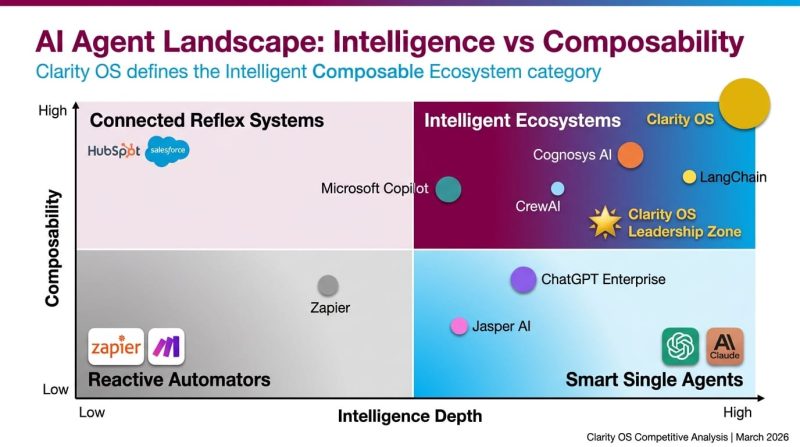
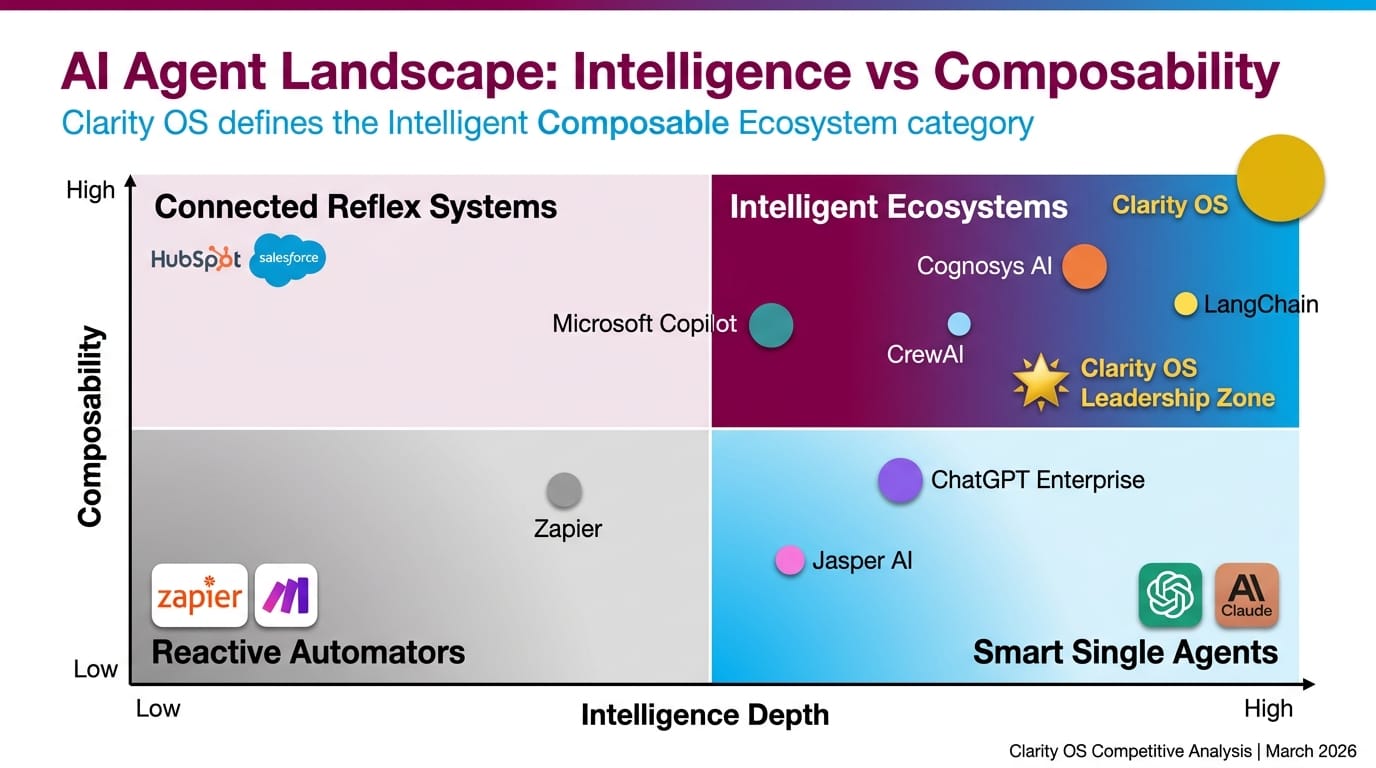
A new Gartner-style matrix analysis, dated March 2026, maps out the current state of the AI Agent landscape. The framework uses two critical axes: Intelligence Depth (vertical) and Composability (horizontal).
The verdict is in. The market is dividing into four distinct quadrants—but there is a new category emerging at the top right. Let’s break down the landscape.
The Four Quadrants of AI Agents in the Era of Intelligent Composable Ecosystem
We have found something: The matrix categorizes current solutions based on how smart they are and how easily businesses can piece them together (compose them) to fit complex business needs.
1. Smart Single Agents (High Intelligence, Low Composability)
In this quadrant, we find tools like LangChain and custom-built Smart Single Agents. These are the brainiacs of the group. They possess deep intelligence, capable of complex reasoning, multi-step planning, and handling nuanced prompts.
However, they operate in silos. In fact, they are typically built as standalone applications or specialized coding libraries. Consequently, while they are powerful, they lack the ability to easily snap into existing enterprise workflows or communicate seamlessly with other agents. The result? You get a brilliant mind, but it often works alone.
2. Reactive Automators (Low Intelligence, Low Composability)
At the bottom left, we have the legacy of the “No-Code” era and basic automation tools. Think Zapier, Microsoft Copilot, and Jasper AI. These tools excel at specific tasks—triggering an email, generating a draft, or moving data from A to B.
But they are reactive. They wait for a human to pull the lever. Their intelligence is shallow; they follow rules rather than reason. While incredibly useful for tactical efficiency, they don’t offer the strategic composability required to run an entire department autonomously.
3. Connected Reflex Systems (High Composability, Low Intelligence)
This is a crowded space featuring giants like HubSpot, Salesforce, and CrewAI. These platforms are masters of connectivity. They have APIs galore, massive ecosystems, and the ability to orchestrate data across different systems.
But they are reactive—meaning they wait for a human to pull the lever. And their intelligence is shallow; they follow rules rather than reason. As a result, while incredibly useful for tactical efficiency, they don’t offer the strategic composability required to run an entire department autonomously.
4. The Leadership Zone: Intelligent Composable Ecosystems
This brings us to the top-right quadrant. According to the analysis, this is the “Leadership Zone,” and it is currently defined by Clarity OS.
Here, the gap between intelligence and composability is finally bridged thanks to Clarity OS, which holds the sole position in the “Intelligent Composable Ecosystem” category.
What Defines an Intelligent Composable Ecosystem?
That raises a key question: to understand why Clarity OS occupies this leadership zone, we have to look at what happens when high intelligence meets high composability.
- Intelligence Depth: Unlike “Reflex Systems” that require if/then logic, Clarity OS uses agents that understand context, intent, and business outcomes—meaning they don’t just execute tasks; they manage objectives.
- Composability: Unlike “Smart Single Agents” that exist in isolation, Clarity OS is built to be modular. It acts as the operating system for the enterprise, allowing businesses to compose—or assemble—precisely the agentic workforce they need, integrating seamlessly with existing legacy software (like Salesforce and HubSpot) rather than attempting to replace them.
The Competitive Analysis (March 2026)
The landscape map is telling. Competitors like ChatGPT Enterprise and CrewAI are currently scattered across the lower quadrants. Consequently, while they are excellent at specific functions (content generation or multi-agent orchestration), they lack the “composable ecosystem” architecture to serve as the single source of truth for enterprise operations.
Clarity OS, however, is positioned as the unifying layer. By combining the reasoning power of advanced AI with the flexibility of a modular architecture, it allows enterprises to finally move beyond the dichotomy of “best-of-breed” (composable but dumb) and “all-in-one” (smart but rigid).
Conclusion: The Market is Converging
The message from this matrix is clear: the market is converging on the top-right.
Businesses are no longer willing to sacrifice intelligence for flexibility, nor flexibility for intelligence. The next era of enterprise software isn’t about standalone agents or simple connectors; it is about Intelligent Composable Ecosystems.
As we move further into 2026, the companies that succeed will be those that adopt a platform capable of growing with them—one that can think deeply while adapting fluidly to the unique architecture of their business.
Clarity OS is leading that charge.
Disclaimer: This analysis is based on market positioning maps and competitive intelligence as of March 2026.
More articles…?
-
The Clarity Principle: Why “Closing” Is Outdated and “Choosing” Is Everything

Clarity Principle The Clarity Principle™ Why “Closing” Is Outdated and “Choosing” Is Everything By Stéphane Metral Technology Perspective™ Series For years, we have measured sales success by one brutal metric: velocity. But in that relentless chase for speed, we have overlooked a fundamental human truth—buyers do not buy when they are pushed. They buy when
-
Clarity OS: The AI Mission Control

Clarity OS: The AI Mission Control :root { –clarity-red: #8b051a; –clarity-blue: #00adee; –gradient-primary: linear-gradient(135deg, #8b051a 0%, #00adee 100%); –gradient-card-front: linear-gradient(145deg, #ffffff, #f4f7fc); –gradient-card-back: linear-gradient(145deg, #f8faff, #edf2f8); –bg-dark: #f4f7fc; –bg-card: #ffffff; –bg-card-hover: #f0f4fa; –text-light: #1a1f2a; –text-muted: #5a6f8a; –text-body: #1e2532; –shadow-card: 0 20px 40px -12px rgba(0, 0, 0, 0.15); –header-bg: rgba(244, 247, 252, 0.92); –nav-bg: rgba(244, 247,
-
From Owner Memory to Business Intelligence

When your business feels like it needs another person, the obvious question is usually: “Who should I hire?” Sometimes that is absolutely the right question. But there is another question worth asking first: What would that person actually need to know to do the job without you? Because many owners do not simply hold the