





One Brain. Every Module. Real Revenue | Clarity OS
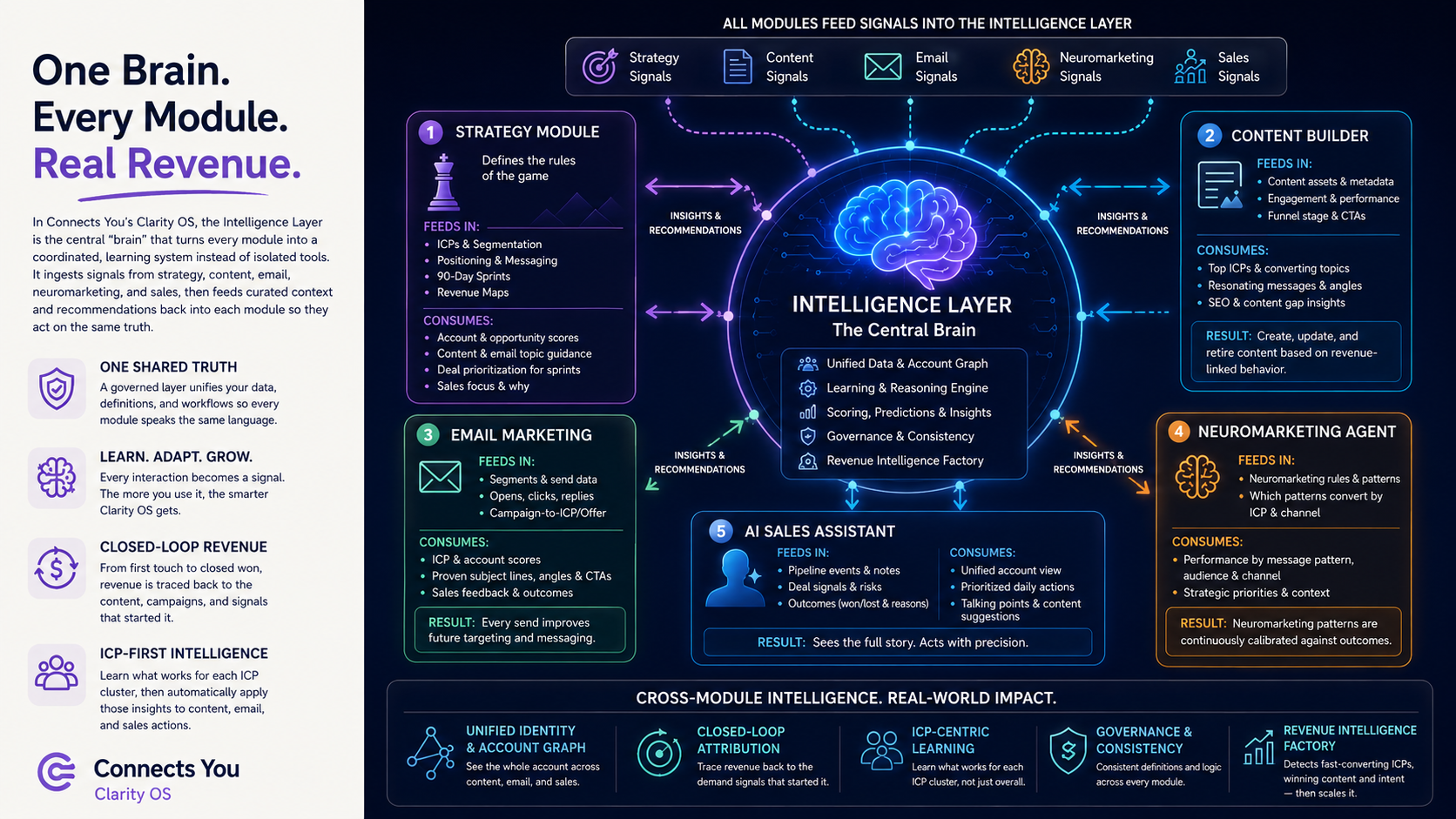
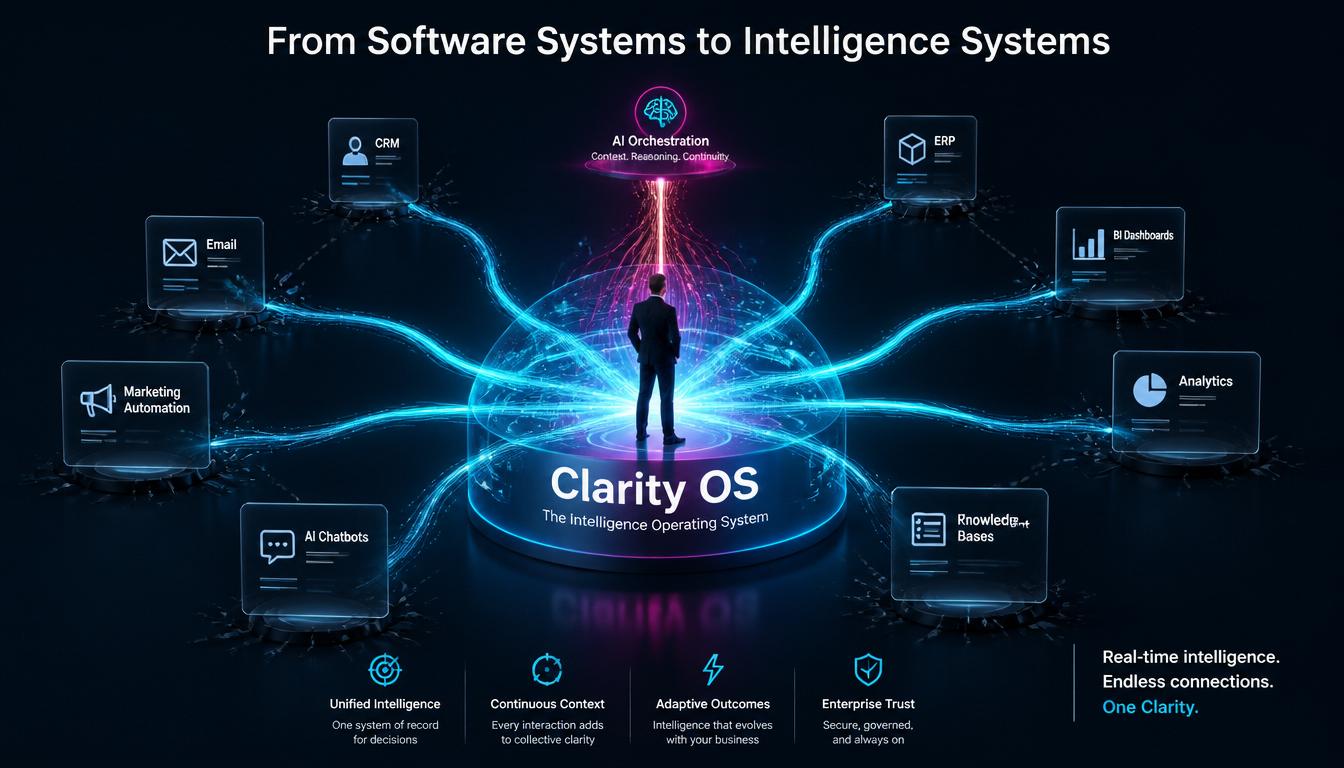
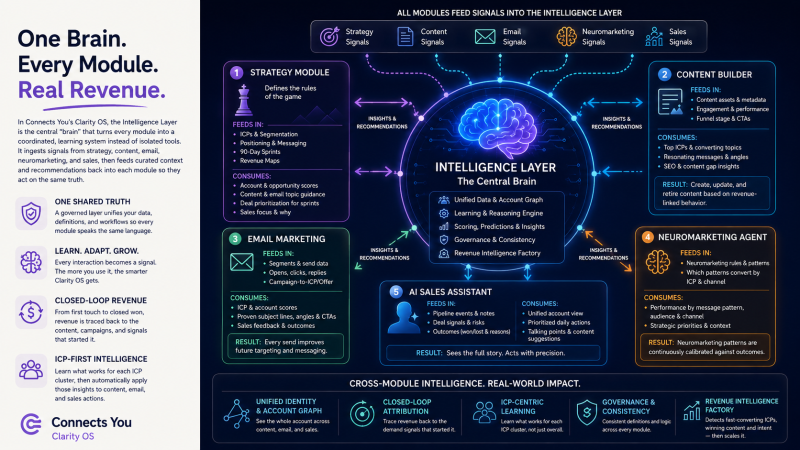
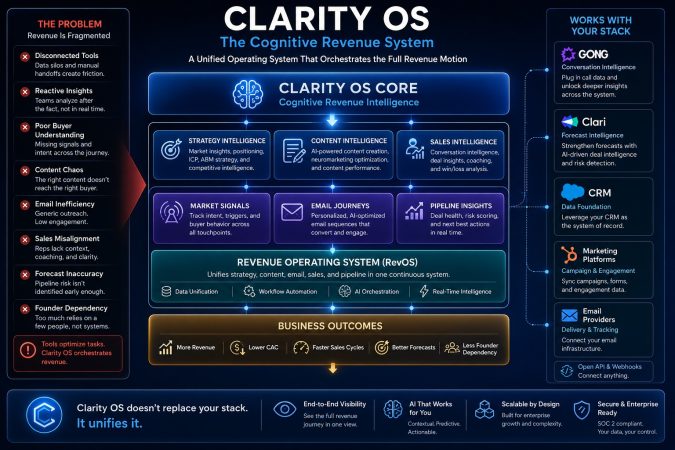
In Connects You’s Clarity OS, the Intelligence Layer is the central “brain” that turns every module into a coordinated, learning system instead of isolated tools. It continuously ingests signals from strategy, content, email, neuromarketing, and sales, then feeds curated context and recommendations back into each module so they act on the same truth.
@Paul Young –
What the Intelligence Layer is
- A governed, shared data and reasoning layer that connects your strategies, content, customer data, and workflows across all modules.
- It “learns from your content, campaigns, and customer data” so every campaign and asset makes the system smarter over time.
- Conceptually, it’s the revenue intelligence factory inside Clarity OS: it traces revenue back to demand signals, detects which ICP clusters convert fastest, and identifies which content triggered buying intent.linkedin
How it integrates with each module
1) Strategy Module → Intelligence Layer
The Strategy Module defines the “rules of the game”:
- ICPs, positioning, messaging pillars, 90‑day sprints, and revenue maps are stored and versioned in the Intelligence Layer.
- The layer uses these definitions to:
- Score and prioritize accounts and opportunities by strategic fit.
- Guide content and email topics so they align with ICP pain points and positioning.
- Tell the Sales Assistant which deals matter most for the current sprint and why.
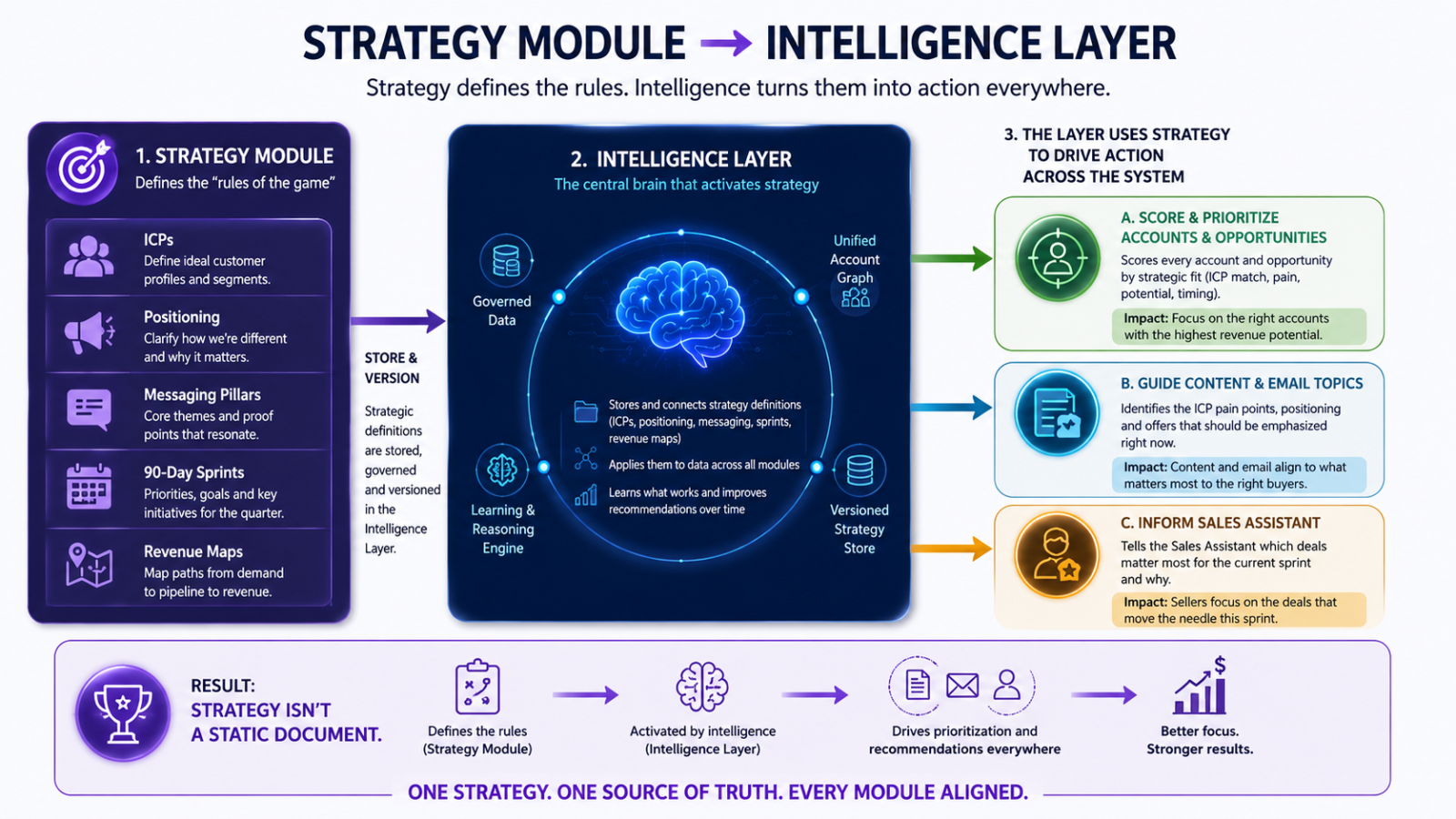
Result: strategy isn’t a static document; it actively shapes prioritization and recommendations everywhere.
2) Content Builder Module ↔ Intelligence Layer
The Content Builder both feeds and consumes intelligence:
- Feeds in:
- Content assets (pages, posts, landing pages, offers) and their metadata (topic, ICP, funnel stage, CTA).
- Performance signals (engagement, time on page, clicks, conversions).
- Consumes from the layer:
- Which ICPs and topics are currently converting best.
- Which messages and angles are resonating (from email and sales outcomes).
- SEO and content gap insights derived from cross‑module performance data.
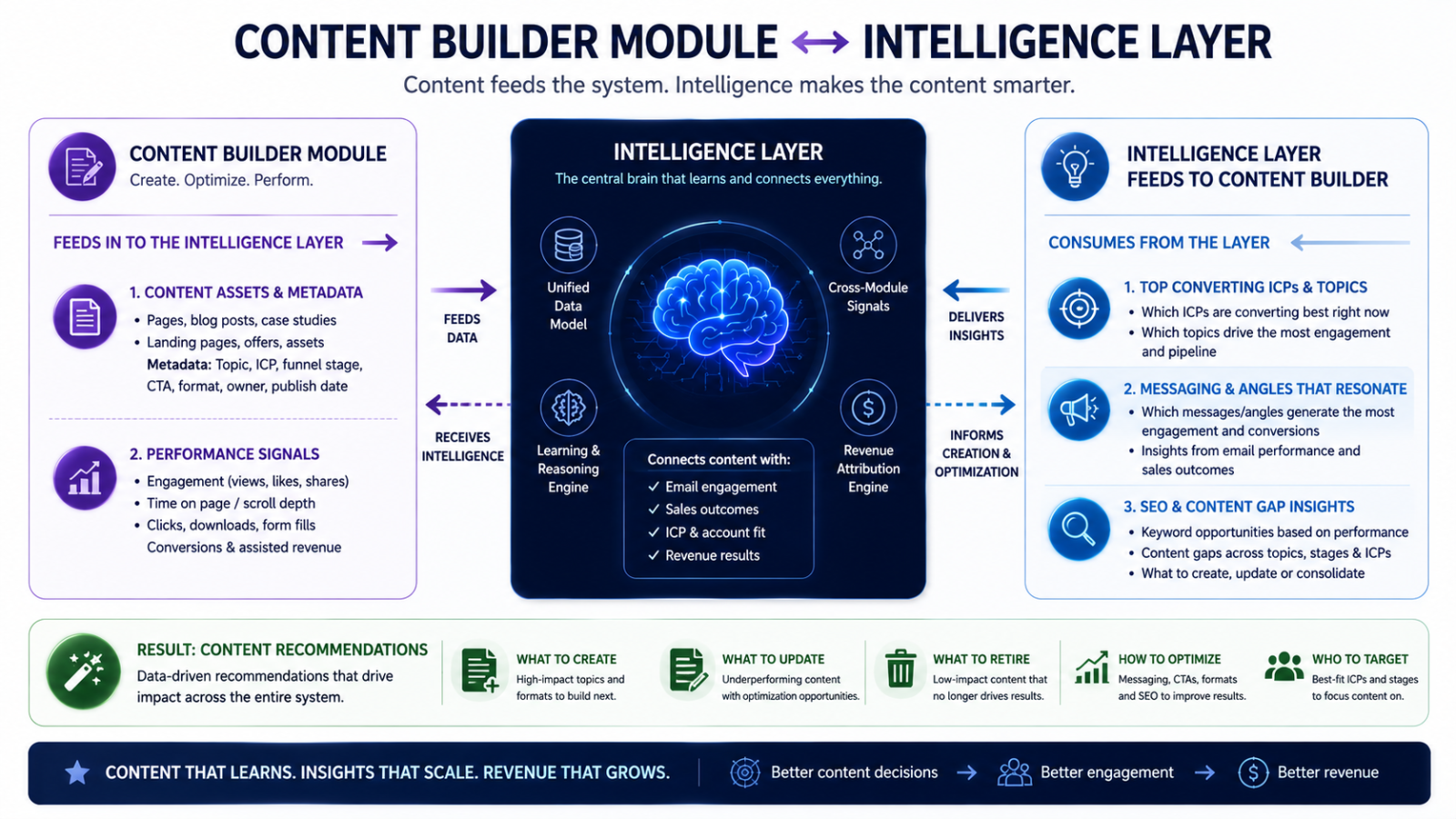
Result: content recommendations (what to create, update, or retire) are based on actual revenue‑linked behavior, not vanity metrics. linkedin
3) Email Marketing Module ↔ Intelligence Layer
Email is a major signal source and an execution channel:
- Feeds in:
- List segments, send data, opens, clicks, replies, bounces, unsubscribes.
- Campaign‑to‑ICP and campaign‑to‑offer mappings.
- Consumes from the layer:
- ICP and account scores to refine segmentation (e.g., “high‑fit, cold” vs “high‑fit, warm”).
- Content performance insights to choose subject lines, copy angles, and CTAs that have proven effective for that segment.
- Sales feedback (e.g., which email‑driven meetings actually progressed) to optimize future sequences.
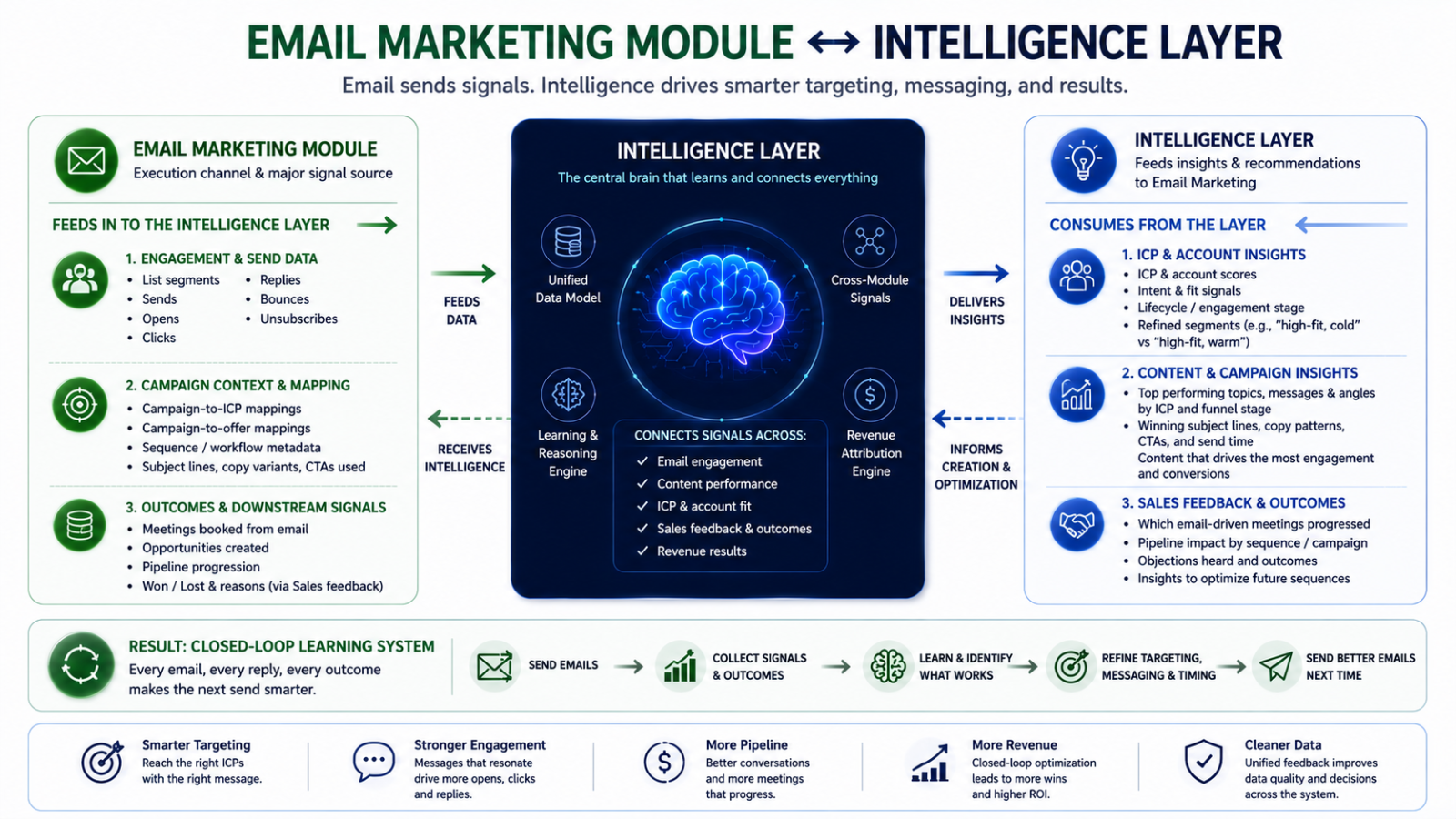
Result: email becomes a closed‑loop learning system where every send improves future targeting and messaging.linkedin
4) Neuromarketing Agent Module ↔ Intelligence Layer
The Neuromarketing Agent encodes how humans actually respond:
- Feeds in:
- Neuromarketing rules and patterns (e.g., framing, loss aversion, social proof structures) applied to content and campaigns.
- Observations about which neuromarketing patterns correlate with higher conversion by ICP and channel.
- Consumes from the layer:
- Real performance data by message pattern, audience, and channel.
- Context on current strategic priorities (e.g., “focus on enterprise ICP in Q3”) to tune which patterns to emphasize.
NEUROMARKETING AGENT → INTELLIGENCE LAYER
Continuous calibration of cognitive science against real-world conversion data.
🧠
1. Neuromarketing Agent
Encoding Rules
- • Framing & Anchor Logic
- • Loss Aversion Triggers
- • Social Proof Structures
Pattern Correlation
Observations of success across specific ICPs and Channels.
Sync Loop
2. Intelligence Layer
The Neural Hub for Action
🌐
Cross-references behavioral patterns with live engagement metrics to validate psychological effectiveness in real-time.
🎯
A. Tune Strategic Emphasis
Layer injects Q3 priorities (e.g., Enterprise ICP focus) to weight patterns.
📊
B. Performance Ingestion
Consumes real outcome data to update “Persuasion Score” per channel.
🔄
C. Dynamic Recalibration
Updates the Agent’s rule-set based on what is actually converting.
🏆
Result: Live Calibration
Neuromarketing shifts from academic theory to a continuously optimized performance asset.
Result: neuromarketing is continuously calibrated against real outcomes instead of staying theoretical.
5) AI Sales Assistant Module ↔ Intelligence Layer
The Sales Assistant is the most direct “revenue co‑pilot” using the layer:
- Feeds in:
- Pipeline events (stage changes, notes, meeting outcomes, next steps).
- Deal signals (time in stage, stakeholder engagement, risk flags).
- Outcomes of sales actions (meetings booked, deals won/lost, reasons).
- Consumes from the layer:
- A unified view of each account: strategy fit, content consumed, email engagement, neuromarketing responses, and past sales interactions.
- Prioritized daily action lists derived from risk/impact models that use cross‑module signals.
- Talking points, objection handling, and content suggestions tailored to the prospect’s actual behavior and ICP profile.
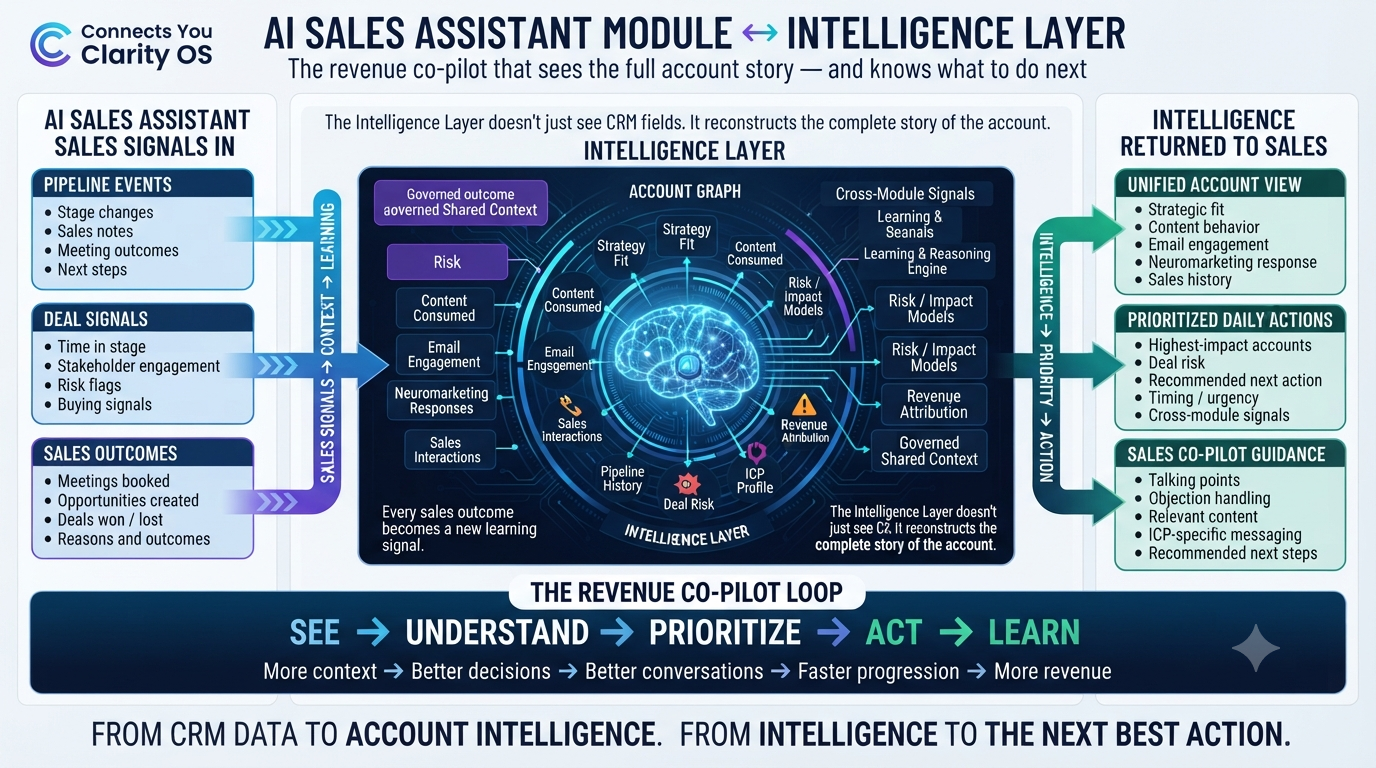
Result: the Sales Assistant doesn’t just see CRM fields; it sees the full story of how that account has interacted with your system.
Cross‑module integration patterns
The Intelligence Layer enables a few key patterns that make the modules work as one system:
- Unified identity and account graph:
Contacts, accounts, and opportunities are linked across content, email, and sales so the layer can reason about “this company” rather than isolated records. - Closed‑loop attribution:
Revenue is traced back through the sales process to the original demand signals (content, email, campaigns), so the layer learns which combinations actually drive deals. - ICP‑centric learning:
Instead of generic “what works,” the layer learns “what works for ICP A vs ICP B,” then pushes those insights into content, email, and sales recommendations. - Governance and consistency:
Because the layer is “governed,” it enforces consistent definitions (e.g., what counts as an ICP, what stages mean) so all modules operate on the same logic.

1. What exactly is “The Intelligence Layer”?
The Intelligence Layer is the foundational architecture or middleware that sits between your individual software modules. Rather than acting as just another tool, it serves as the “brain” of the ecosystem, providing the logic, data processing, and communication rules that allow disparate parts of the system to function cohesively.
2. What are the “key patterns” mentioned, and why do they matter?
While the text references specific key patterns (which typically include orchestration, event-driven messaging, and centralized data contextualization), these patterns are the standardized blueprints the Intelligence Layer uses to handle interactions. They matter because they prevent each module from having to “speak” a different language; instead, they provide a repeatable, predictable set of rules for how data is shared, processed, and acted upon across the entire platform.
3. How does the Intelligence Layer make the modules work as “one system” instead of separate tools?
It achieves this by abstracting away the unique complexities of each module. Instead of forcing modules to directly integrate with one another (which creates a tangled “spaghetti” architecture), the Intelligence Layer acts as a universal translator and traffic controller. It ensures that data is synchronized in real-time, workflows are passed seamlessly between modules, and the user experiences a single, unified interface—making the backend modules feel like a single, monolithic application even if they are built separately.
5–8 minutes