





From Owner Memory to Business Intelligence

When your business feels like it needs another person, the obvious question is usually: “Who should I hire?”
Sometimes that is absolutely the right question.
But there is another question worth asking first:
What would that person actually need to know to do the job without you?
Because many owners do not simply hold the responsibility for the work. They hold the invisible knowledge that makes the work possible. They know what to look for, which exceptions matter, what customers really mean when they say something, which decision should be made quickly and which one needs more investigation. They know the shortcuts, the workarounds and the little signals that have been learned through years of doing the work.
The business may have employees, software, documents and processes.
But the operating knowledge can still live primarily in one person’s head.
And that is a very different problem from simply being understaffed.
The scale of the owner workload makes this more than a theoretical problem.
A 2025 BDC survey of 609 Canadian entrepreneurs revealed they average 49.7 weekly working hours, with over half exceeding 50 hours, and more than 40% feeling crushed by workload. Yet delegation remains sporadic:
a July 2026 follow‑up found that two in five entrepreneurs delegate only occasionally.
The obstacles are practical—quality worries, tight budgets, missing internal expertise, and crucially, no time to train newcomers.
This training bottleneck is telling: the very person who needs relief is also the sole teacher of the business’s inner workings, making the owner both the problem and the supposed solution.
Because owners must train each new hire, they keep performing the tasks. This creates a self‑feeding cycle:
the more they execute, the more tacit knowledge they accumulate; the more knowledge they hold, the harder to offload responsibility; the harder the transfer, the more indispensable they become.
Each working hour deepens their understanding, while every handover attempt exposes gaps only they can fill.
So the loop tightens—less delegation concentrates knowledge, which further discourages delegation, trapping entrepreneurs in an ever‑expanding cage of their own expertise.
Technology has tackled only the storage side—shared drives, CRMs, wikis, and SOP libraries abound. But archiving information is not the same as rendering it actionable.
A procedure may instruct “review the proposal,” yet misses the owner’s silent cues: which client fights costs, which signal shifts the pitch, which past conversation holds the key.
That contextual intelligence lives between documents, decisions, and histories. Hence the next frontier isn’t better documentation—it is connected business knowledge, where relationships among data, customers, and choices become navigable, breaking the owner’s monopoly on meaning.
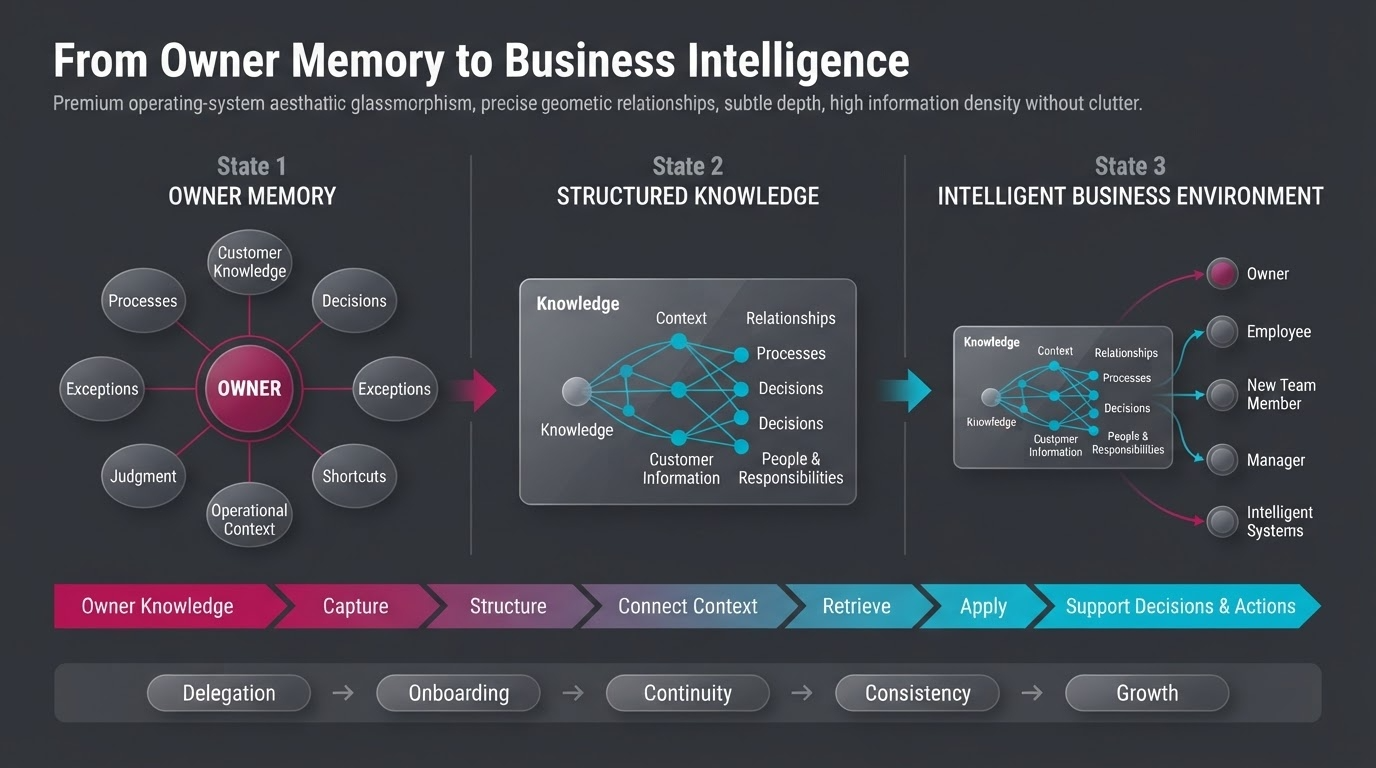
The difference is important.
Documentation attempts to preserve what someone knows.
A structured knowledge environment can begin to represent how that knowledge relates to the business.
Processes can be connected to people.
People can be connected to responsibilities.
Responsibilities can be connected to decisions.
Decisions can be informed by customer information, previous interactions, business rules and exceptions.
The objective is not to create a giant database of everything the company has ever produced.
The objective is to make the knowledge that matters available in the context in which it matters.
That is where intelligent systems become interesting.
Research into knowledge management in SMEs has repeatedly identified the central role of the owner-manager in organizational development and decision-making. A 2023 systematic review covering 180 research papers on knowledge management in SMEs noted that the founder or owner-manager often occupies a central position, increasing the likelihood that strategy and decision-making remain concentrated in one person or a small number of people.
In other words, this is not merely an AI opportunity.
It is an organizational architecture problem.
AI simply gives us a new technological mechanism for addressing it.
The interesting question becomes:
✦ Clarity OS · Knowledge Architecture
🧠 structured intelligence
❶ The Human API Problem
⚡ The Owner Bottleneck — every unanswered question becomes an interruption. Every interruption competes with the work that actually grows the business.
🧩
Human API
The owner becomes the only gateway to everything the business knows.
interruption × growth
“Ask me if you’re not sure.”
That sounds harmless. But multiply it across customers, operations, sales, finance, delivery and exceptions. The owner becomes the human API of the company. Every unanswered question becomes another request — another interruption that competes with the work needed to grow.
📐
Structured Context
Deliberately captured knowledge that explains why.
context > answers
Beyond “ask the owner”
Now imagine that knowledge is deliberately captured and structured. The new employee accesses relevant context — not just what the business does, but why. The owner is still involved where judgment matters, but no longer the only gateway.
📈
Growth Equation
Scalability isn’t about hiring — it’s about transferable knowledge.
knowledge architecture
Documenting ≠ Transferable
A business becomes scalable when knowledge can move through the organization without being personally transmitted by the founder every time. That’s the distinction between preserving information and changing how the organisation operates.
❷ New Operating Model
🔄 A New Operating Model — the business moves from “Ask Stéphane” to “Here is the context you need.”
🧠
From Memory
Knowledge used to live only in the founder’s head.
isolated → connected
Individual memory → structured intelligence
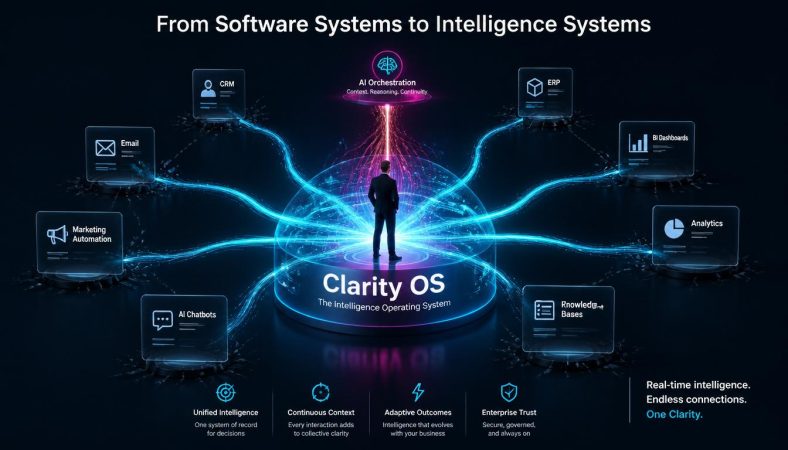
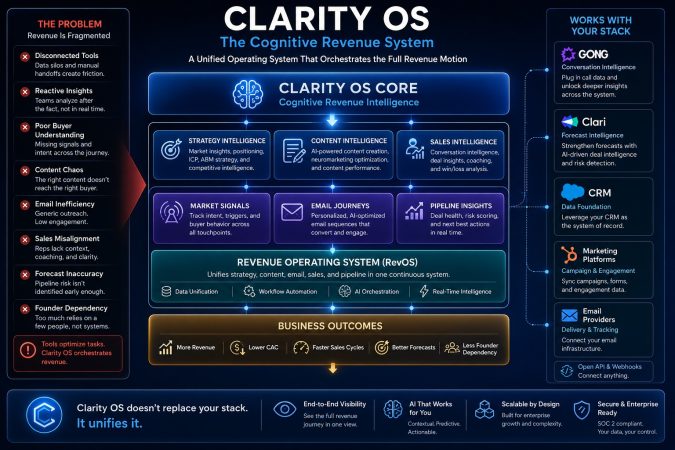
Clarity OS explores what happens when business knowledge moves from isolated information and individual memory toward a structured, connected intelligence environment. The goal isn’t simply to answer questions — it’s to establish a context where information is interpreted in relation to other information.
👤
Human in the Loop
Technology is not a replacement — it’s an amplifier.
judgment + context
Valuable ≠ replaceable
The valuable thing about the owner is precisely the knowledge, judgment and experience that made the business work. The problem is that the business hasn’t had a way to make that knowledge usable beyond the person who created it. Clarity OS keeps the human in the loop — but not as the sole operating system.
🔁
Delegation & Continuity
Onboarding becomes a transfer of context, not just tasks.
scalable onboarding
“Here is the business context you need.”
The business starts moving from “Ask the owner” toward a model where the system surfaces the relevant information. This makes delegation, onboarding and continuity more interesting — and changes the growth equation. Hiring more people isn’t the answer; making knowledge transferable is.
❸ The Real Constraint
🧩 The Real Constraint — before you hire another person, ask: “Where does that knowledge currently live?”
🏛️
Knowledge Architecture
Not a people problem — a knowledge architecture problem.
systemic constraint
If it only works in your head…
Before you decide that your business simply needs another person, ask: “What does that person need to know?” Then ask: “Where does that knowledge currently live?” If the answer is mostly “In my head.” — you’ve found the real constraint. That’s not a people problem yet. That’s a knowledge architecture problem.
🎯
Owner Dependency
Dependency is not binary — it can be decomposed.
identify · isolate · reduce
Make the invisible visible
Owner dependency is not binary. You can identify where it exists, what knowledge creates it, and what must change before another person could operate independently. That’s where intelligent knowledge systems have a practical role — not in making businesses less human, but in making human experience more available to the organisation.
🚀
The Path Forward
Technology can finally address the knowledge architecture gap.
Clarity OS · Connects You
Ready to grow beyond your head
Explore the idea further through Connects You and
Clarity OS. See what happens when a real business knowledge problem
is turned into a structured intelligence workflow.
“If it only works in your head, it isn’t ready to grow.”
💡 Interactive widget: The original concept includes a dependency simulator. The flip cards above capture the essence — owner dependency can be decomposed, and structured knowledge changes the growth equation.
CONNECTS YOU / CLARITY OS
Question 1 of 8
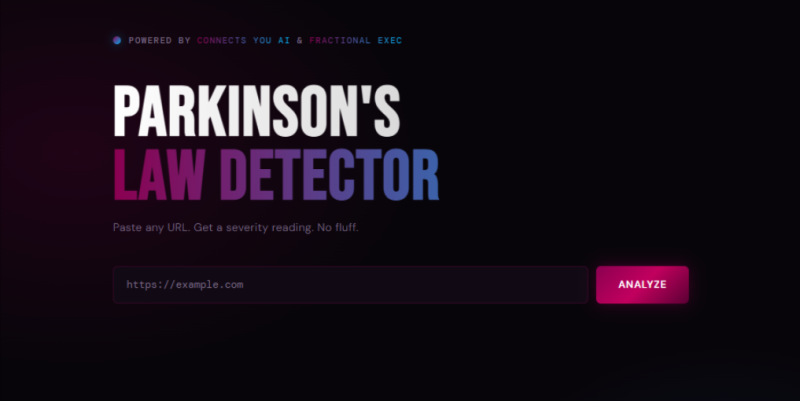
Owner Dependency Scenario Simulator
Is your business too dependent on what you know?
Answer eight quick questions about how your business actually runs. We’ll show you where knowledge dependency is concentrated today — and what could change if more of that knowledge became accessible.
No sign-up. No email. Nothing you enter is stored or transmitted — the whole experience runs in your browser.
QUESTION 1
Illustrative scenario indicator
Your Owner Dependency Profile
Based on how you described your business — not a scientific score, a scenario picture.
OWNER → KNOWLEDGE → DECISIONS → WORKFLOWS → TEAM
This is an illustrative scenario model, not a scientific diagnostic. It uses your answers to visualize where business knowledge appears concentrated and what might change if more of that knowledge became structured and accessible.
System view
Where the dependency lives
Six things every business runs on. The thicker the connection, the more it currently routes through you.
The shift
From owner memory to structured knowledge
Before
Critical knowledge is concentrated in the owner.
Knowledge shift
Structure the knowledge. Connect the context.
Possibility
More of what you know becomes usable beyond you.
Try it yourself
What if you changed one thing?
Move the sliders below and watch how the picture changes on the right — nothing here is being saved, this is just a scenario.
Your scenario
Possible future state
Key takeaway
This is the problem we are interested in at Connects You.
Clarity OS explores what becomes possible when critical business knowledge moves from individual memory into a structured, connected intelligence environment — one your whole team, and your systems, can draw on.
Owner Dependency Scenario Simulator — an interactive experience by Connects You
Created by Margaret Ann Davis & Stephane Metral
CONNECTS YOU / CLARITY OS
A New Operating Model
From bottleneck to leverage
It introduces the solution and changes the narrative from “problem” to “opportunity.”
“Now imagine that some of that knowledge has been deliberately captured and structured.”
📚
Captured & Structured
Knowledge is deliberately captured and organised.
context over guesswork
Accessible business context
The new employee can access the relevant business context. The person can understand not only what the business normally does, but the information that explains why.
🖥️
System-Surfaced
The system helps surface relevant information.
intelligence at the point of need
Information finds you
The system can help surface the relevant information without requiring a direct ask. This shifts the burden from the owner’s memory to the architecture of the business itself.
⚙️
Operating Model Shift
The owner is still involved — but not as the only gateway.
judgment · authority · experience
That is a very different operating model
The owner is still involved where judgment, authority or experience
genuinely matter. But the owner no longer has to be the
only gateway to everything the business knows.
This changes the growth equation entirely.
💡 The takeaway: This is the shift from owner‑dependent memory to a structured, connected intelligence environment — where the system supports the human, not the other way around.
Interactive model — Connects You / Clarity OS
Designed to explore business knowledge transfer
CONNECTS YOU / CLARITY OS
The Role of Intelligence
Not replacement. Amplification.
It addresses the elephant in the room — the fear of AI replacing the owner — and
defines the product philosophy.
“The technology is not intended to ‘replace the owner with AI.’ That would misunderstand the problem.”
🤝
Not Replacement
The technology is not intended to replace the owner with AI.
human + machine
Misunderstanding the problem
The valuable thing about the owner is precisely the knowledge, judgment and experience that made the business work in the first place. Replacement is not the goal — amplification is.
🧩
The Real Problem
Knowledge trapped in individual memory.
isolation → accessibility
Beyond the person who created it
The business has not necessarily had a way to make enough of that knowledge usable beyond the person who created it. That is the real constraint we are solving for.
🌐
Connected Intelligence
Moving from isolated information toward a structured environment.
clarity os · exploration
A structured, connected intelligence environment
Clarity OS is part of our exploration of what happens when business knowledge moves from isolated information and individual memory toward a structured, connected intelligence environment.
💡 The philosophy: Intelligence systems exist to take what is valuable about human experience — context, judgment, pattern recognition — and make more of it available to the organisation that experience built.
Interactive model — Connects You / Clarity OS
Designed to explore business knowledge transfer
CONNECTS YOU / CLARITY OS
From Memory to Context
The growth equation changes.
It dives deeper into the “why” and moves from technical explanation
to business strategy — scalability.
“That distinction is important because the goal is not simply to answer questions.”
🎯
Interpretation, not just answers
The larger opportunity is business context.
context over answers
Information interpreted in relation
That distinction is important because the goal is not simply to answer questions. The larger opportunity is to establish a business context in which information can be interpreted in relation to other information.
🔄
From “Ask the owner” to “Here is the context”
Delegation, onboarding and continuity become more interesting.
the shift
Possibility emerges
That is what makes the possibility of delegation, onboarding and continuity more interesting. The business starts moving from “Ask Stéphane” or “Ask the owner” toward: “Here is the business context you need.”
📈
Scalability & Transferability
Documenting vs. making the business transferable.
growth equation
One preserves. The other transforms.
There is still a human being in the loop. There should be. But the
human is no longer necessarily carrying the entire operating system
in their head. And that changes the growth equation.
A business does not become scalable merely because it hires more
people. It becomes more scalable when the knowledge required to
operate it can move through the organization without having to be
personally transmitted by the founder every time.
That is the distinction between documenting a
business and making a business transferable.
One preserves information. The other starts changing how the
organization can operate.
💡 The strategic takeaway: Scalability is not a hiring problem — it is a knowledge‑architecture problem. When context is transferable, the organisation can grow without the founder becoming the bottleneck.
Interactive model — Connects You / Clarity OS
Designed to explore business knowledge transfer
CONNECTS YOU / CLARITY OS
The Real Constraint & The Path Forward
If it only works in your head, it isn’t ready to grow.
It delivers the final punchline — the knowledge architecture problem —
and issues a clear call to action.
“Before you decide that your business simply needs another person, ask a different question.”
🤔
Ask the Right Question
Before you hire another person, ask a different question.
diagnose first
What does that person need to know?
Before you decide that your business simply needs another person,
ask a different question:
What does that person need to know?
Then ask:
Where does that knowledge currently live?
If the answer is mostly “In my head.” — you may have found
the real constraint.
🏛️
Not a People Problem
You may have a knowledge architecture problem.
the real diagnosis
A problem technology can address
You may not have a people problem yet.
You may have a knowledge architecture problem.
And that is a problem technology can finally begin to address.
The constraint isn’t the people — it’s
the accessibility of what they need to know.
🚀
Ready to Grow
If it only works in your head, it isn’t ready to grow.
call to action
Explore the idea further
Explore the idea further through Connects You and
Clarity OS.
See what happens when a real business knowledge problem is turned
into a structured intelligence workflow.
“If it only works in your head, it isn’t ready to grow.”
⚡ The opportunity is not to remove yourself from the business — it is to make more of what you know available to the business.
Interactive model — Connects You / Clarity OS
Designed to explore business knowledge transfer