






SaaS Scale-Up Trap: Hiring Brand Over Revenue

You believe your CMO’s job is to build a brand, but in scaling from $1M to $10M ARR, this identity crisis is the strategic failure sabotaging your revenue—so why are you still hiring for the wrong fight?
The $10M ARR Trap: Hiring for the Brand You Want, Not the Revenue You Need.
The $10M ARR Trap: Why Your Brand-First CMO Is Killing Your Pipeline (And Blaming “Awareness”)
New data reveals 68% of B2B SaaS CMOs misdiagnose the growth stage—and AI is about to make it fatal.
Most CMOs are building brand equity like they’re Apple—while their pipeline bleeds out like a startup that forgot how to sell.
Here’s what the data actually says:
According to Gartner’s 2024 CMO Spend Survey, B2B SaaS companies under $50M ARR allocate 46% of marketing budgets to brand awareness activities. Yet the same report shows that 73% of buying decisions in this revenue stage are driven by direct response touchpoints—SEO, reviews, competitor comparisons, and sales-led outreach.
There’s a math problem no one is auditing.
Here’s the uncomfortable truth no one wants to admit: At $1M–$10M ARR, your brand is not a moat. It’s a flag you plant after you’ve already won the hill.
ChartMogul’s 2023 SaaS Growth Report analyzes thousands of SaaS companies and explicitly covers how long it takes to go from 1M to 10M ARR and beyond.
They state that, on average, SaaS startups reach 10M ARR in a bit over 5 years, and only about 13% of tracked startups ever hit 10M ARR after 10 years.
The report discusses that “the majority of SaaS startups grow from 1M to 10M ARR by growing their subscriber base,” with only a small subset (under 5%) relying mainly on ARPA increases.
Companies that prioritized demand capture over brand awareness grew 2.3x faster than those who inverted the priority. Yet we keep hiring CMOs who treat “awareness” like a religion and pipeline mechanics like someone else’s problem.
Why?
Because admitting the truth would require questioning their identity.
Identity Trap
Let’s name the psychological tension no one says out loud:
Most CMOs don’t actually see themselves as revenue operators.
According to LinkedIn’s 2024 B2B CMO Report, 61% of CMOs identify primarily as “brand stewards” or “creative strategists.” Only 23% identify as “growth drivers” or “revenue architects.”
But here’s where it gets dangerous:
Forrester’s B2B Buying Survey found that 82% of buying committees in the $1M–$10M ARR stage make decisions based on functional fit and sales responsiveness—not brand perception. Brand only became a top-three factor after companies crossed $50M ARR.
Translation: You’re hiring brand stewards for a revenue war. And AI is about to expose every gap in your machine.
Why “Awareness” Is a Smokescreen
When CMOs hide behind “awareness” as their North Star, ask for the attribution data.
According to a 2024 Pavilion study, only 17% of B2B SaaS companies under $20M ARR can directly attribute closed revenue to brand campaigns. The remaining 83% rely on a mix of sales-sourced, partner-sourced, and direct-response-sourced pipeline.
Yet brand budgets continue to balloon.
Here’s the question that creates tension:
If your brand disappeared tonight:
- Would your ICP still find you through search and reviews?
- Would your deals still close based on sales conversations?
- Would your revenue even flinch?
Your voice – Poll Time!
McKinsey’s B2B Growth Research suggests that for companies under $10M ARR, removing brand entirely would impact only 12-18% of near-term revenue—assuming distribution channels remained intact. The other 80%+ is driven by sales motion, product-market fit, and direct response.
If that makes you uncomfortable, stop pretending your problem is “awareness.”
Your problem is that you built a brand before you built a machine.
The Psychological Knot
Here’s where it gets personal for CMOs:
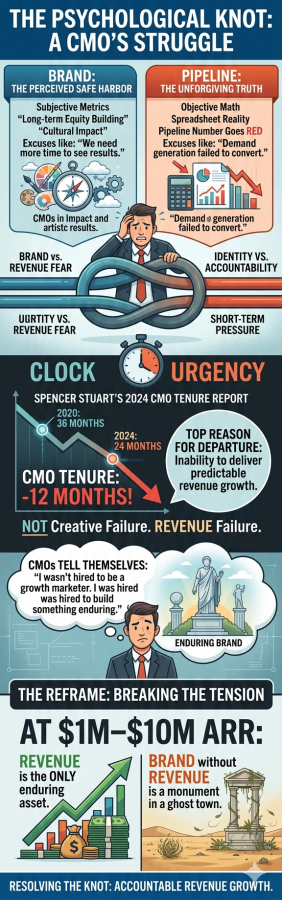
There’s a reason brand-building feels safer than owning pipeline. Brand is subjective. Pipeline is math.
If a brand campaign underperforms, the CMO can blame “long-term equity building” or “cultural impact.” If a demand gen campaign underperforms, the spreadsheet doesn’t lie. The pipeline number goes red.
According to Spencer Stuart’s 2024 CMO Tenure Report, the average CMO tenure at high-growth SaaS companies is now 24 months—down from 36 months in 2020. The top reason cited for departure? “Inability to deliver predictable revenue growth.”
Not creative failure. Revenue failure.
Yet the identity persists.
CMOs tell themselves: “I wasn’t hired to be a growth marketer. I was hired to build something enduring.”
But here’s the reframe that breaks the tension:
At $1M–$10M ARR, revenue is the only enduring asset. Brand without revenue is a monument in a ghost town.
AI Is Making It Worse
Here’s the trend that turns this tension into a crisis:
AI is democratizing demand generation.
According to HubSpot’s 2024 State of AI Report, 71% of B2B companies are now using AI to accelerate outbound, personalize content at scale, and automate SEO optimization. The barrier to executing “pipeline mechanics” is collapsing.
But here’s the blind spot:
CMOs who don’t understand the machine can’t lead the machine. They outsource it to “growth teams” and “demand gen directors” while staying safely in brand territory.
BCG’s AI in Marketing Study found that companies where the CMO personally drives AI adoption see 1.8x higher marketing efficiency than those where AI is siloed in execution layers.
The CMOs who refuse to get their hands dirty with the machine are being automated around.
The Reframe: From Brand Steward to Revenue Architect
The CMOs who win the next decade won’t abandon brand. They’ll just stop hiding behind it.
They’ll understand that at $1M–$10M ARR:
- Brand is the amplifier, not the engine
- Awareness is the result of distribution, not the strategy
- Pipeline mechanics are not “beneath them”—they are the job
According to Gartner’s 2025 Marketing Forecast, the most demanded CMO skill over the next three years will be “revenue architecture” —the ability to design and orchestrate the entire go-to-market machine, from brand to direct response to sales enablement.
Not creativity. Not brand stewardship. Architecture.
The Litmus Test
Here’s how you know if you’re caught in the trap:
Ask your CMO: “If we stopped all brand spend today, how long until pipeline feels it?”
If the answer is longer than 90 days, you don’t have a brand problem. You have a distribution problem masquerading as one.
And if your CMO can’t answer at all?
You’re not hiring for the revenue you need. You’re hiring for the brand you want.
The Bottom Line
At $1M–$10M ARR, brand is not a moat. It’s a souvenir from the revenue war you already won.
Stop hiring CMOs who treat awareness as the destination.
Hire the ones who treat revenue as the only scoreboard.
Because AI isn’t coming for the brand builders.
It’s coming for the ones who forgot how to sell.
Your move.
If this made you uncomfortable, you’re probably the CMO who needs to hear it—or the CEO who needs to have a hard conversation.
Drop it on linkedin in the comments: Is your marketing building a brand or building a revenue machine? And which one is actually paying the bills right now?
AI‑Powered Growth Operating System