





The 15 AI Trends That Will Separate Leaders from Followers.
Most companies are still treating AI like a fancy calculator.
15 AI Trends
The leaders? They’re treating it like a new species of worker.
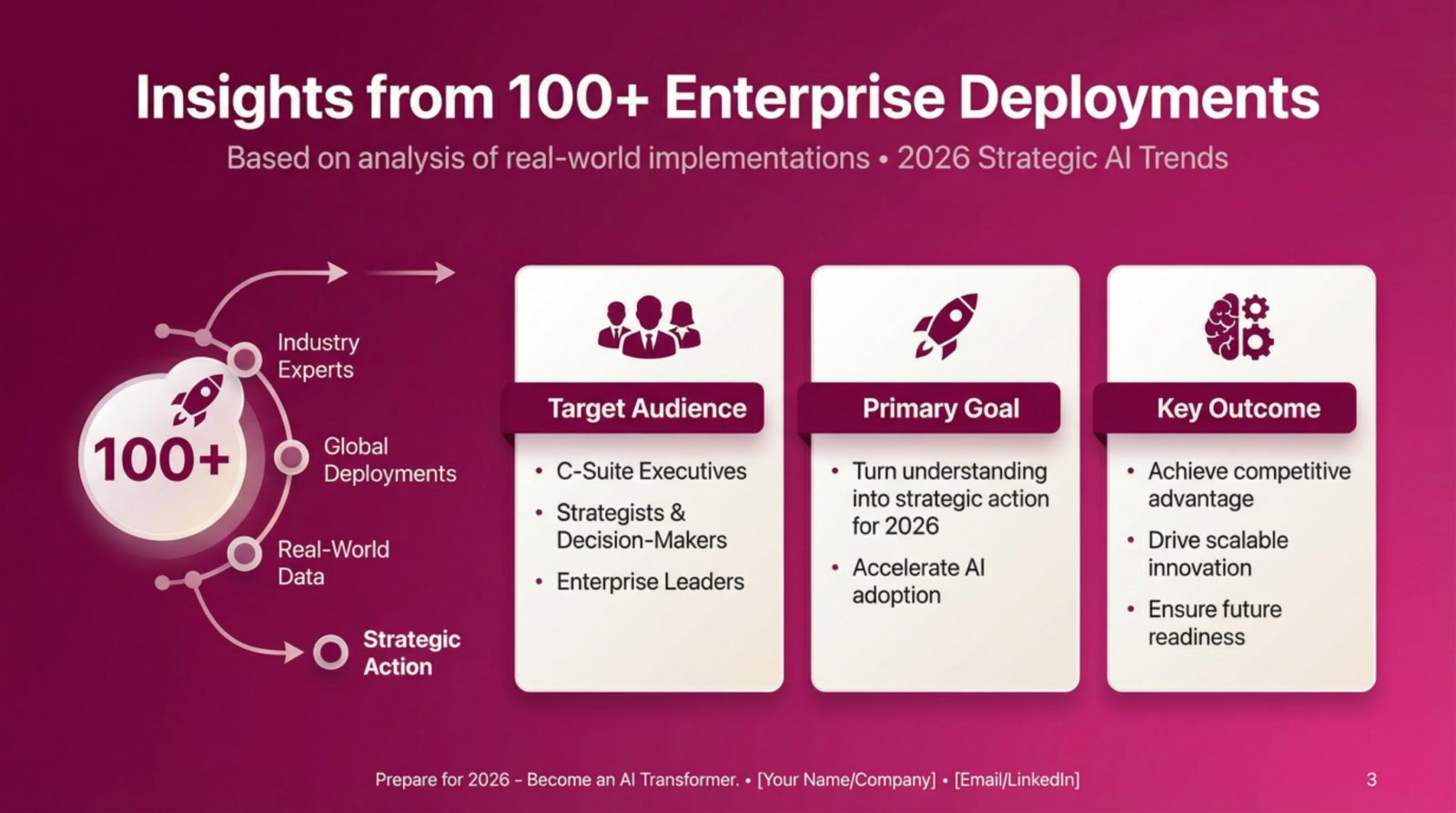
After analyzing 100+ enterprise deployments and consulting with industry experts, we’ve identified the strategic trends that matter most right now:
🧠 Agentic AI – Not chatbots. Digital employees that execute autonomously.
🤖 Physical AI – Intelligence that moves, builds, and interacts with the real world.
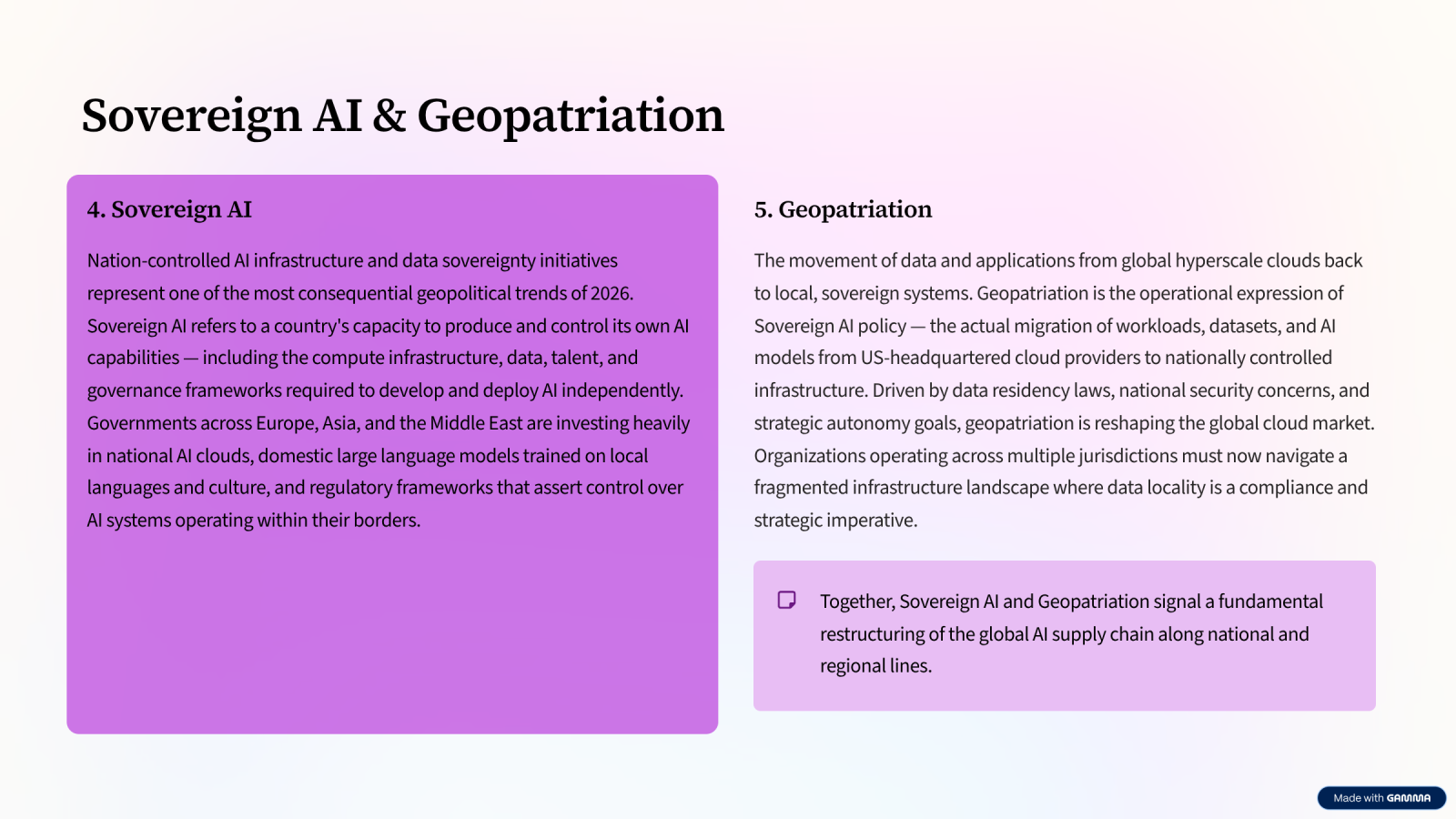
🌍 Sovereign AI – Why nations are racing to control their own AI infrastructure.
📱 Post-Smartphone Era – The end of apps as we know them.
Strategic AI Trends 2026
The foundational concepts shaping AI strategy in 2026 — a comprehensive guide to the 15 most critical trends redefining how organizations, nations, and individuals interact with artificial intelligence. From autonomous agents to sovereign infrastructure, these trends represent the frontier of AI development and deployment.
Connects You Podcast | Watch now!
Agentic & Physical AI
1. Agentic AI
Autonomous AI systems that plan and execute multi-step tasks independently — without requiring human intervention at each step. Agentic AI represents a fundamental shift from reactive tools to proactive digital workers capable of setting sub-goals, using external tools, browsing the web, writing and running code, and iterating toward complex objectives. In 2026, agentic frameworks are moving from experimental to enterprise-grade, powering everything from automated research pipelines to autonomous customer service resolution.
2. Physical AI
AI integrated directly into physical machines, robots, and hardware systems. Physical AI closes the loop between digital intelligence and the material world — enabling machines to perceive, reason, and act in real environments. Industrial robots, autonomous vehicles, smart manufacturing equipment, and logistics automation are all expressions of Physical AI. The convergence of powerful foundation models with real-time sensor data is accelerating deployment across factories, warehouses, and infrastructure.
3. Embodied AI
A closely related but distinct concept, Embodied AI refers to AI systems that possess a physical form and are capable of real-world interaction through that body. Unlike Physical AI (which may be embedded in existing machinery), Embodied AI systems — such as humanoid robots — are designed from the ground up to navigate, manipulate, and learn from physical environments. This trend is driving significant investment in humanoid robotics and general-purpose robotic platforms.
Moving Beyond the “Fancy Calculator” Phase
Too many organizations still view Artificial Intelligence as a supplementary tool—a more efficient way to crunch numbers or draft emails. However, the current reality in 2026 is that leaders have graduated from using AI as a “fancy calculator” to treating it as a new species of worker. While followers focus on incremental task speed, leaders are integrating autonomous intelligence into the very fabric of their operations, turning AI from an “add-on” into an essential, intelligent colleague.
Evidence-Based Strategy: 100+ Enterprise Deployments
Strategic decisions shouldn’t be based on hype, but on hard data. Our analysis draws directly from over 100 enterprise AI deployments, providing a clear-eyed look at what works in the real world. This session is designed specifically for decision-makers who need to move past the experimental phase and into high-impact, strategic action. We’ve distilled the successes and failures of global industry leaders to provide a roadmap for 2026.
The Rise of Agentic AI
The era of the simple chatbot is over. In 2026, Agentic AI represents the shift toward digital employees that can execute complex, multi-step workflows autonomously. Unlike previous iterations that required constant human prompting, these agents orchestrate entire assembly lines of digital tasks—from supply chain adjustments to end-to-end customer resolution. Organizations adopting agentic architectures are seeing upwards of a 30% reduction in operational costs while freeing human talent for high-level strategy.
Physical AI and Real-World Interaction
AI is no longer confined to the screen. Physical AI is the trend of 2026 that bridges the gap between digital intelligence and tactile action. Through advanced robotics and drones, AI is now managing inventory, assisting in healthcare, and streamlining manufacturing with unprecedented precision. By bringing “brains” to “bodies,” companies are drastically reducing human error in hazardous environments and achieving a level of physical efficiency that was once the stuff of science fiction.
The Necessity of Sovereign AI
As data becomes the most valuable commodity on earth, Sovereign AI has emerged as a critical trend for national and corporate security. Organizations are moving away from “black box” third-party models in favor of localized data centers and custom-built infrastructure. This shift ensures total control over intellectual property and regulatory compliance, allowing industries like finance and defense to innovate without compromising their most sensitive data.
Entering the Post-Smartphone Era
We are witnessing the end of “apps” as the primary way we interact with technology. In the Post-Smartphone Era, AI interfaces are becoming ambient—driven by voice, gesture, and intent rather than menus and icons. For businesses, this means a total revolution in customer engagement. Retailers and service providers are shifting toward personalized, “invisible” experiences where the AI anticipates the user’s needs before a single button is pressed.
The Technical Powerhouse
The middle tier of 2026 trends focuses on the engine room of innovation: Multimodal capabilities, Quantum integration, Infrastructure efficiency, and Security. Multimodal AI allows for deeper insights by processing text, video, and audio simultaneously, while Quantum-AI begins to solve problems that were previously mathematically impossible. Crucially, as we scale, Efficiency and Security serve as the guardrails, ensuring that AI growth is both environmentally sustainable and protected against increasingly sophisticated cyber threats.
Organizational Transformation
AI is moving from a specialized tool to an enterprise-wide resource. These trends highlight the acceleration of R&D through AI-driven research and the resilience provided by Federated AI, which keeps models vendor-independent. Furthermore, the rise of Domain-Specific Models means that legal, medical, and manufacturing sectors no longer rely on generalities but use precision-engineered intelligence. In 2026, AI isn’t just a department; it’s an organizational nervous system.
ROI and Intelligent Operations
The final trends for 2026 center on the bottom line: ROI and Value Realization. This is the year where “show me the money” becomes the mantra for every AI project. Through Intelligent Operations and Cloud 3.0, organizations are building self-healing ecosystems that scale effortlessly. The distinction is now clear: leaders have built “AI factories” that consistently churn out value, while followers are still stuck in the “pilot project” loop.
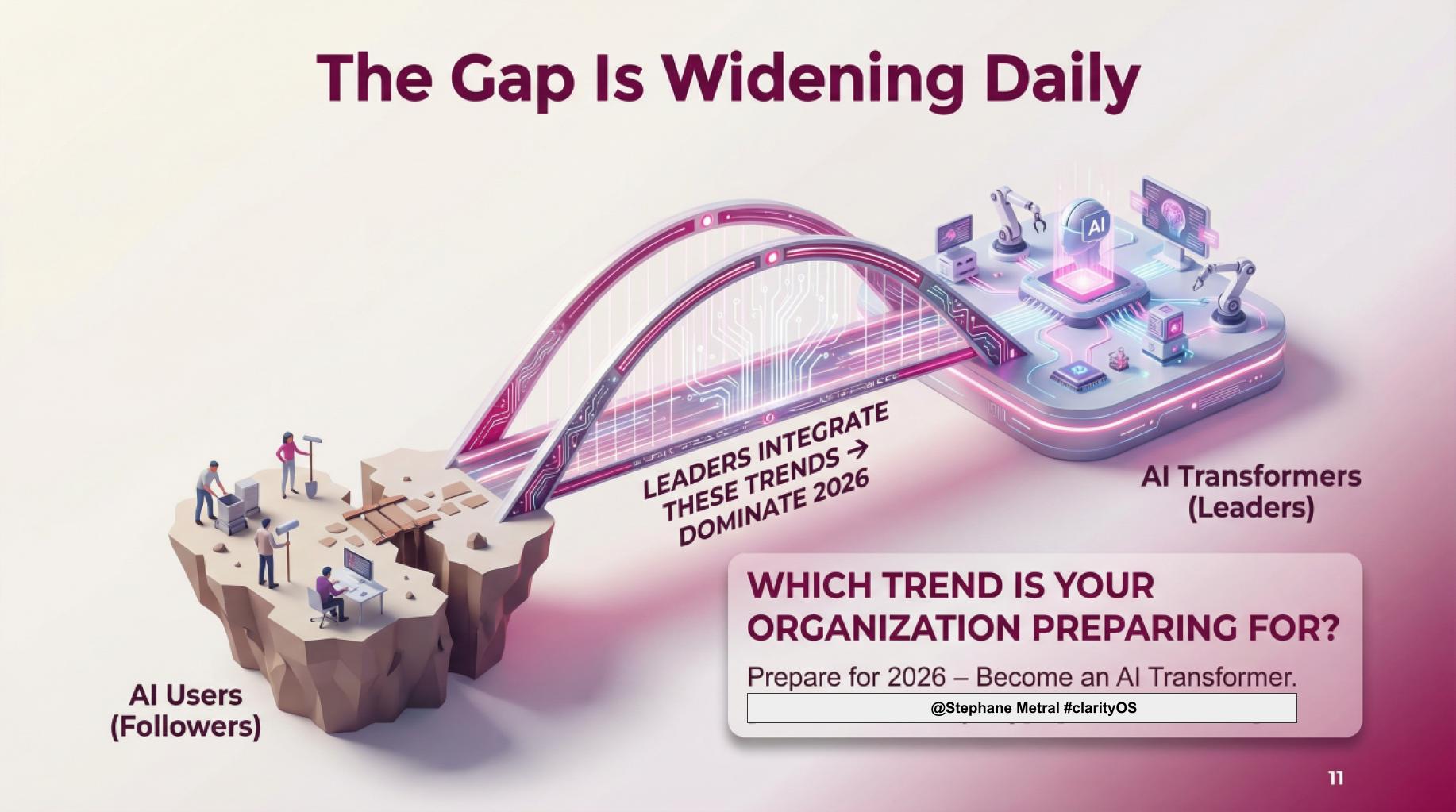
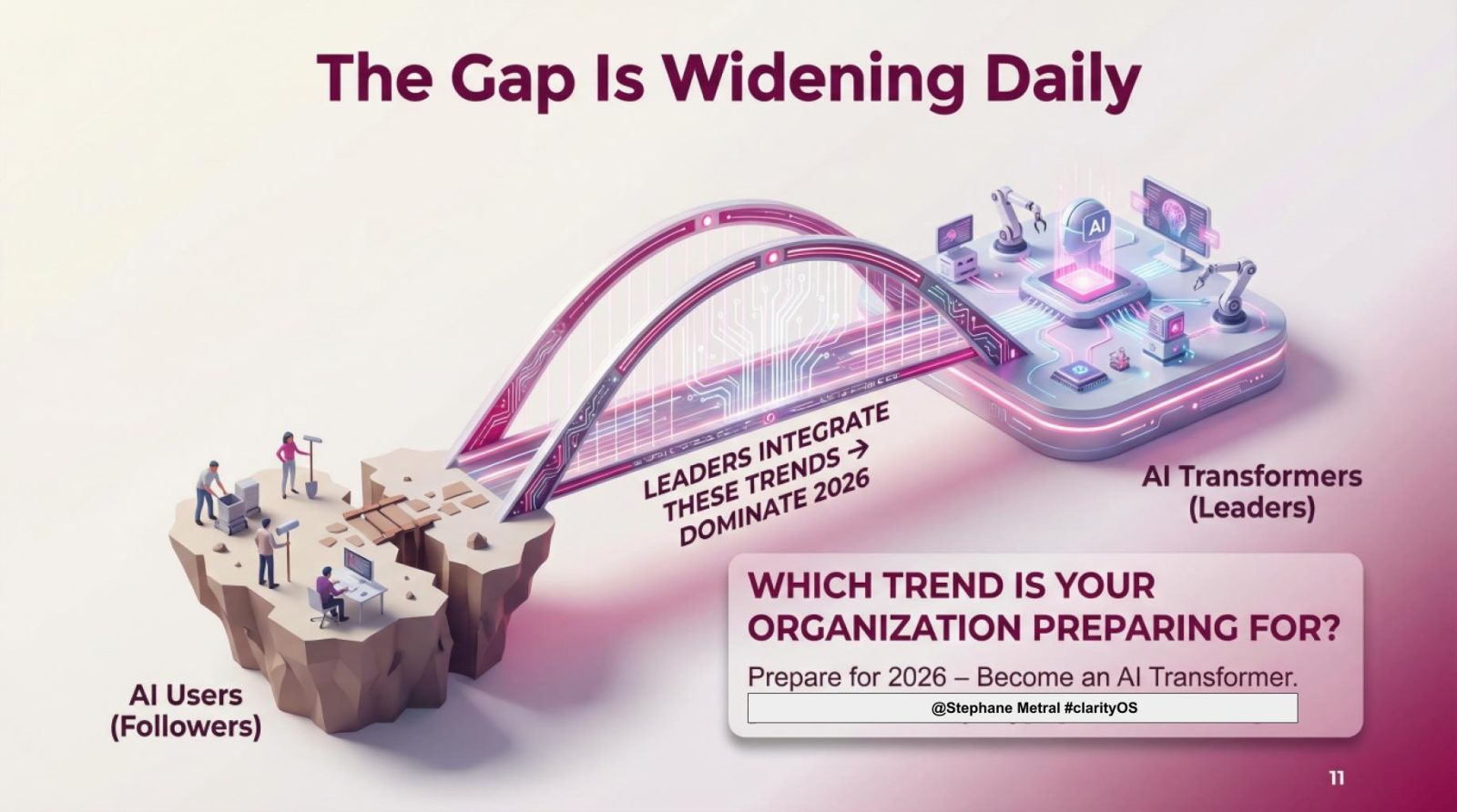
The Widening Gap: A Call to Action
The window of opportunity to lead is closing. The gap between “AI Users” and “AI Transformers” is widening daily, and the compounding returns for early leaders are becoming insurmountable. As we look at the 15 trends of 2026, the question for every executive is no longer “Will AI change my business?” but “Which of these trends will I master before my competition does?” The time to transition from tinkering to dominating is now.
Conclusion: Becoming an AI Transformer
Thank you for joining this exploration of the 2026 AI landscape. The future of work, competition, and global innovation depends on the strategic choices made today. To become an AI Transformer, you must move beyond the hype and integrate these 15 trends into your core business model. Let’s connect to discuss how your organization can bridge the gap and lead the next era of intelligent enterprise.